Week 2
Introduction
To work safely in the collision repair shop, technicians must recognize the dangerous tasks and materials encountered on the job. Technicians must know how to protect themselves and their fellow workers from these dangers. They must also take steps to protect the vehicles in the shop and the shop itself.
Collision Repair Shop Hazards
There are many hazards encountered in the collision repair shop. The technician must be aware of these hazards and take appropriate steps to minimize the potential dangers associated with them.
The following sections highlight the most common hazards found in the collision repair shop.Both chronic and acute hazards are encountered in the shop. A chronic hazard can cause long-term health damage, usually as the result of repeated or prolonged exposure to the hazard.
For example, breathing sanding dust will gradually fill the air sacs in a technician's lungs. Similarly, breathing low levels of solvent vapors or mists over a long period of time can cause liver, kidney, or brain damage.A vapor results from a volatile liquid evaporating into the air.
A mist is made when a liquid, like paint, is dispersed by air pressure during spraying. The same damage can occur if solvents are allowed to repeatedly contact the skin over a long period.Solvents can be absorbed through the skin, or they can enter the skin through a cut.
By either means—breathing in the vapors or allowing liquid solvents to contact the skin—the chemicals enter the bloodstream and travel to various organs.Chemicals may also be accidentally ingested. For example, if the technician does not wash his hands before eating, the paint on his hands may be ingested along with food.
A neurotoxin is a chemical that can cause chronic damage to the central nervous system. Symptoms of central nervous system damage include problems with vision, coordination, and judgment. Lacquer thinners and enamel reducers are examples of common neurotoxins.Blood toxins inhibit the ability of red blood cells to carry oxygen.
Exposure to a blood toxin may make breathing difficult. Blood toxins include hardeners and clearcoats. Liver toxins, such as lacquers and urethanes, cause long-term liver damage.
Reproductive toxins cause damage to the genetic information, or DNA, passed from parent to offspring. Birth defects, which can range from negligible to debilitating, result from damaged DNA.Reproductive toxins include acrylic lacquers and urethanes.
Carcinogens are cancer-causing agents. There are many types of cancer, but all cancer is unregulated cell growth.Some cancers cause tumors. Sealers and any other paint products that contain silica are possible carcinogens.
An acute hazard is a hazard that causes an immediate (or within a few hours) reaction. A single exposure to an acute hazard can cause health problems. These problems may or may not be permanent.
For example, an unprotected individual will become sensitized to isocyanate vapor or mist. Isocyanates are found in hardeners, which are added to paint to increase its durability.
This person will then suffer an acute reaction whenever even a slight amount of isocyanate is present in the air. The acute reaction to isocyanates causes asthma-like symptoms.
A sensitized individual should not work in a collision repair shop because further exposure to even small amounts of isocyanates will cause progressively more severe reactions.
Fire Hazards
Collision repair and refinishing operations and materials can easily cause a fire. Fire is one of the most devastating accidents that can occur in a collision repair shop.
Good housekeeping and careful use of equipment will help prevent fires. Good housekeeping involves keeping the work area clean and well organized.
This includes throwing away used masking paper, wiping cloths, cardboard packaging, and other flammable substances. Never allow flammables to pile up in a corner. Store them in an appropriate container until they can be disposed of properly.
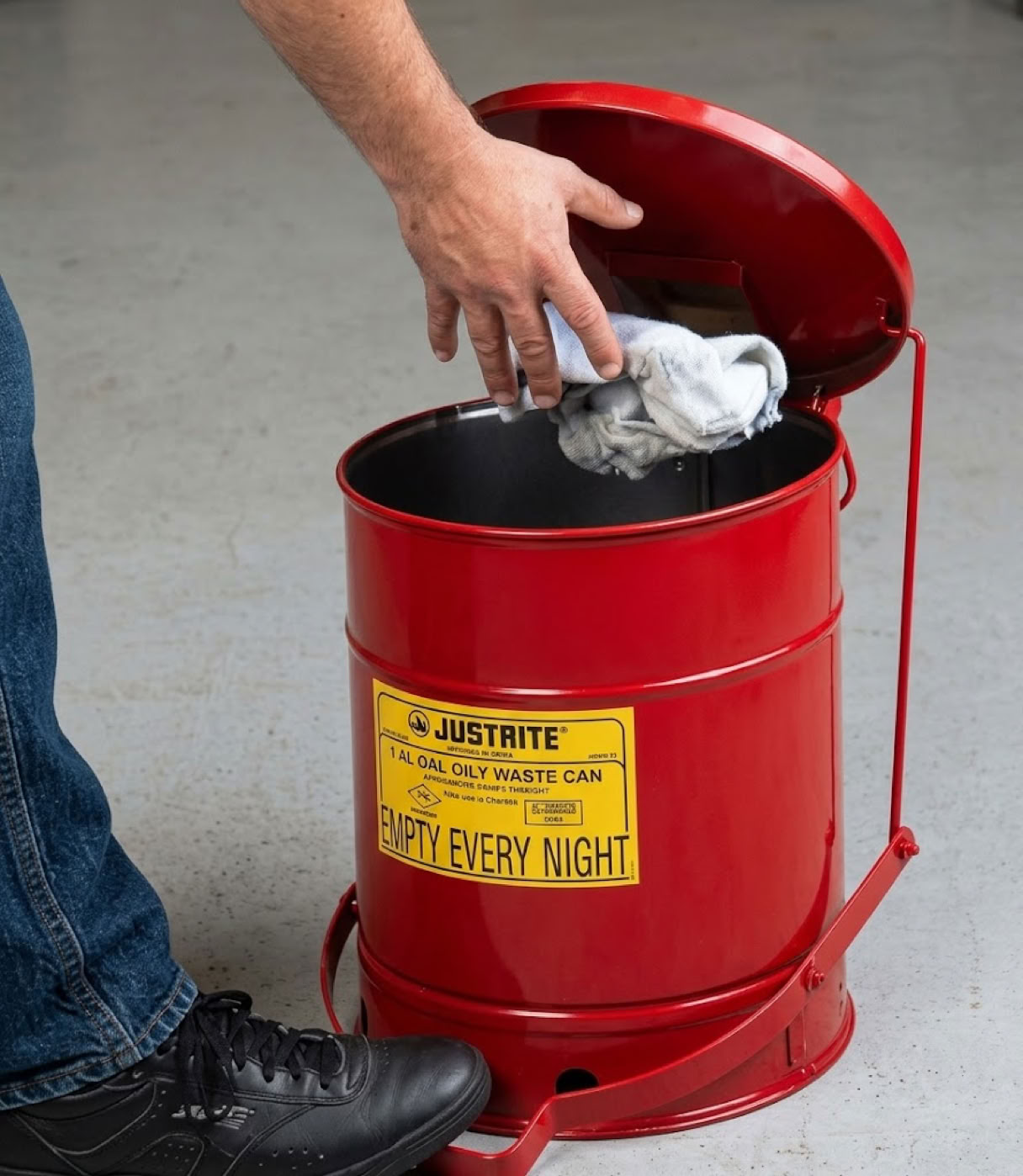
Use caution when lighting a torch or using a MIG welder. Remove combustibles from the work area and be observant. Before welding, make sure the back of the panel being repaired is accessible.
This will allow you to see if undercoat or insulation catches fire. If there is smoke rising out of a panel or cavity, there is likely a fire within the cavity. When this occurs, take appropriate steps to extinguish the fire.
Never smoke in the paint storage, mixing, or spraying areas.It is much easier to prevent a fire than it is to put it out. However, if a fire does start, be aware that the smoke from a fire is a more frequent cause of death than the heat of a fire. The smoke can be toxic and suffocating.
Breathing the smoke may cause you to lose consciousness. Never enter a smoke-filled room to put out a fire. Doing so will put you at great risk. Instead, get out of the building and call the fire department.
Some shops are equipped with a sprinkler system to help extinguish fires. The system detects the heat of a fire and sprays the shop with water, extinguishing the flame.
Fire Extinguishers
Small fires can be put out with fire extinguishers. A fire needs combustible material, heat, and oxygen in order to burn. If you remove one of these elements, the fire will stop. Fire extinguishers are designed to put out fires by removing either heat or oxygen.
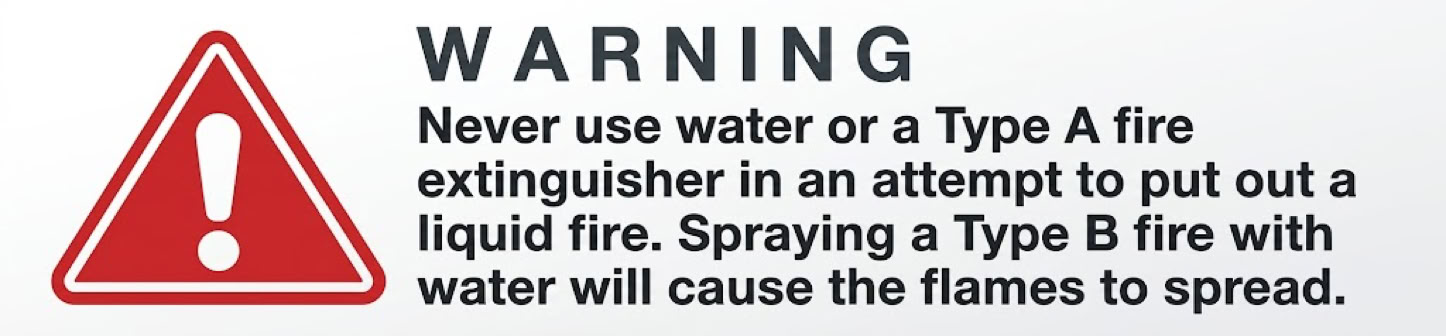
Fires are classified by the type of material that is burning. Wood, paper, plastic, or cloth fires are classified as Type A fires.Type A fires can be extinguished by lowering the temperature of the combustibles.
The Type A fire extinguisher is designed for use on Type A fires and uses water to lower the temperature of the combustibles.Burning liquids, such as paint, thinner, and gasoline, are considered Type B fires.
This type of fire should be smothered to remove the oxygen.Use a Type B fire extinguisher on burning liquids. Some Type B extinguishers use foam. The foam floats on the surface of the burning liquid, cutting off the oxygen and smothering the fire.
Other Type B fire extinguishers use carbon dioxide to put out fires. The carbon dioxide sprayed from the extinguisher displaces the oxygen around the burning liquid, smothering the fire.
Type C fires involve electrical equipment, such as motors, wiring, or switches. Before trying to extinguish this type of fire, shut off the electrical power if possible.
A Type C fire extinguisher will apply a blast of nonconductive powder to smother the electrical fire.
Type C fire extinguishers are often called dry chemical extinguishers.
Type D fires involve burning metals, such as magnesium. To extinguish this type of fire, a Type D, dry-chemical fire extinguisher should be used.
A chart illustrating various fire classifications and fire extinguisher types is shown.
A multipurpose fire extinguisher can be used for a variety of fires. The most common type of multipurpose extinguisher is an A, B, C dry-chemical fire extinguisher.
Know where the fire extinguishers are located in the shop. Take time to learn how to use the extinguishers before you need them. If you wait until a fire breaks out, it may be too late.
Explosion Hazards
Volatile liquids are the primary explosion hazard encountered by the collision repair technician. A volatile liquid is a liquid that evaporates readily when exposed to the air. The vapors created as volatile liquids evaporate are extremely flammable.
These vapors can build up during storage to a concentration that is great enough to explode if exposed to a spark or flame. Volatile liquids include gasoline, lacquer thinner, enamel reducer, and many carbon-based solvents.
Carbon-based solvents can release volatile organic compounds, or VOCs. In addition to being explosion hazards, VOCs can cause air pollution (photochemical smog) and health problems for technicians.
When a volatile liquid is atomized, or broken up into small droplets, the mist created presents an even greater explosion hazard than the liquid itself.Atomization produces a much greater concentration of vapors in a shorter period of time than evaporation.
Liquid paint is atomized in a spray gun. Atomization of the liquid allows a smooth coat of paint to be applied to a surface.Paint should be sprayed only in approved locations, such as in a spray booth or paint prep station.To prevent the buildup of vapors or mists, the mixing area, storage area, and spray area must be properly ventilated.
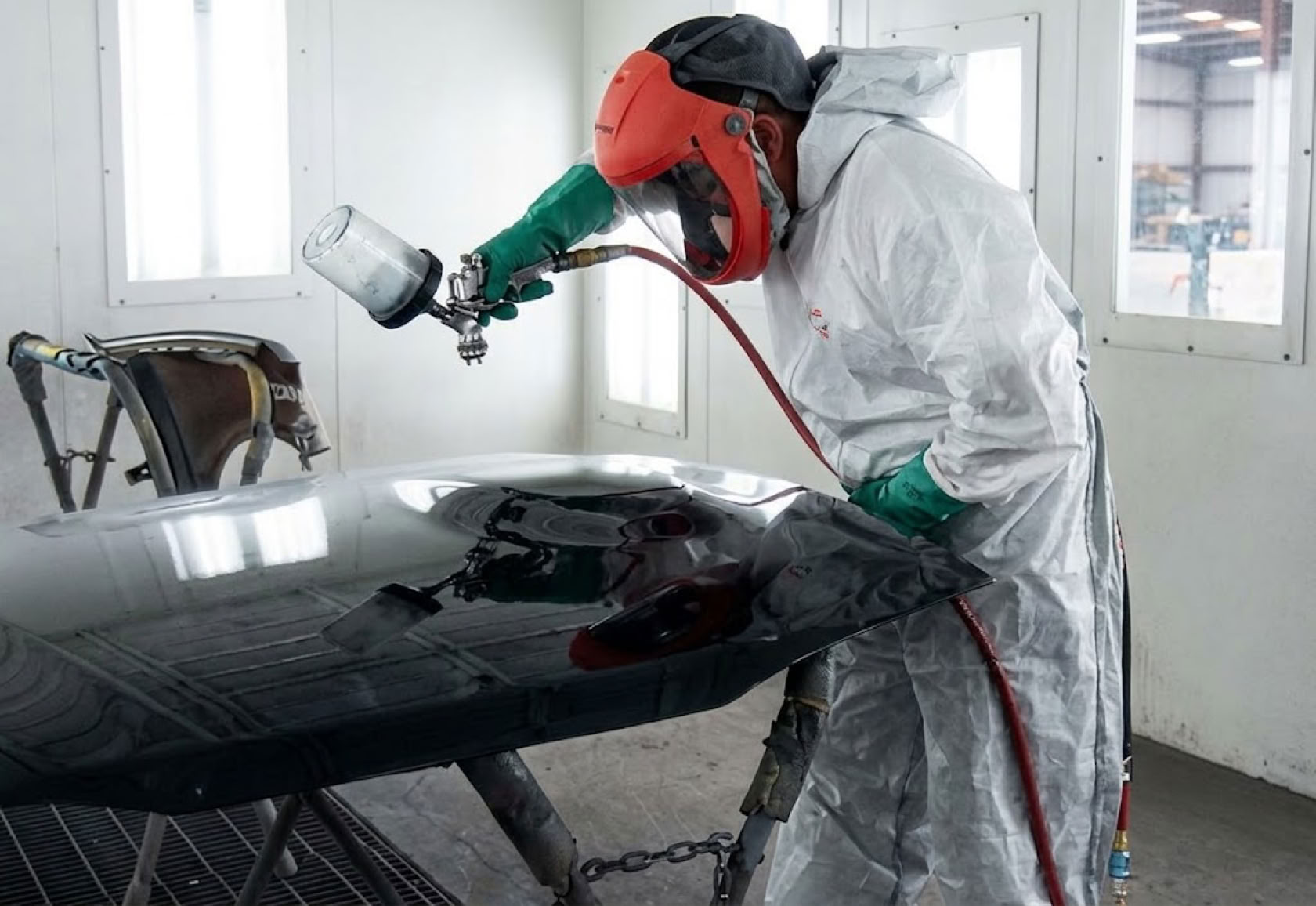
A ventilation system moves air through the shop, replacing contaminated air with fresh air. The replacement of all the contaminated air in a confined area, such as a paint mixing room or paint storage room, is called an air change.
Fire protection codes will specify the number of air changes per hour needed to prevent the buildup of a hazardous concentration of vapor.In a spray booth, the velocity of the air moving through the booth, measured in lineal feet per minute (FPM), prevents the buildup of a hazardous concentration of mist.
The ventilation system in the spray booth removes the mist, replacing the contaminated air with fresh, filtered air. In one type of spray booth, a minimum air velocity of 100 FPM is required for safe operation.
The spray booth exhaust fan pulls the mist-laden air from the booth. This air is filtered and then discharged outside the building. Most spray booths are also equipped with an intake fan to push fresh air into the booth.
This fresh air, taken from outside the building, is called make up air.In cold climates, the make up air is often heated before it enters the booth. Some paint prep stations have curtains instead of walls like a spray booth.
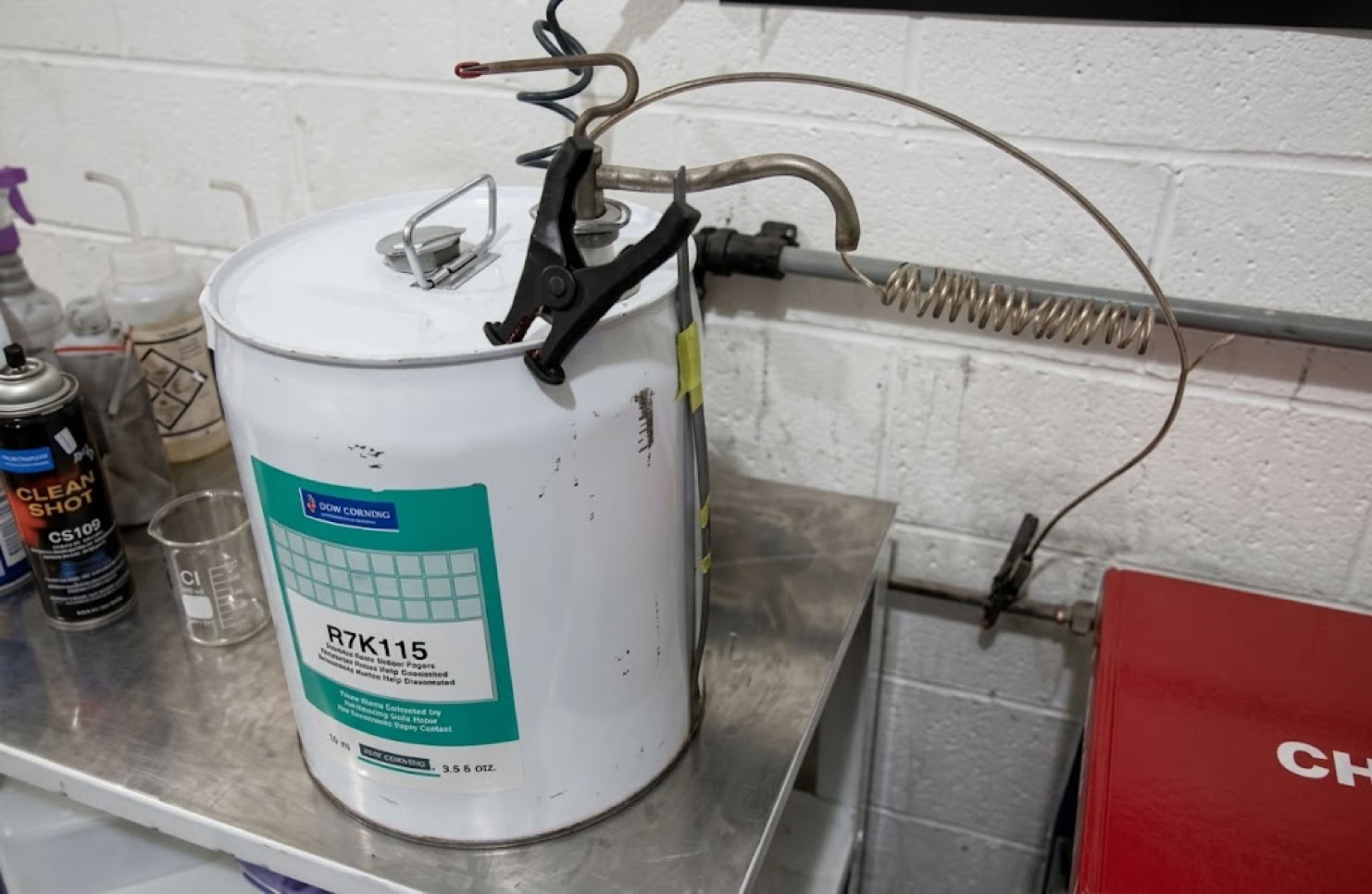
They also have an exhaust fan and, in some cases, an intake fan.A spark caused by static electricity can create an explosion as lacquer thinner is transferred from a metal drum to a smaller metal container.
To prevent an explosion, connect the drum to a good ground.The smaller metal container should be a safety can with a self-closing lid, and it should be connected to the drum with a ground wire. In this way, both the drum and the safety can are grounded. The wire connecting the drum to ground should remain in place the entire time the drum is stored.
When sanded, aluminum creates a dust, which can cause an explosion. Use a water extraction (wet mix) system to prevent an explosion when sanding an aluminum panel.
A wet mix system safely captures aluminum dust by using water to keep the potentially explosive dust from becoming airborne inside the vacuum unit.
Chemical and Biological Hazards
The primary chemical hazards in a collision repair shop are found in the paint products. Solvents, such as enamel reducer and lacquer thinner, are added to paint to dilute it to a sprayable consistency.The process of adding solvents to paint is called reduction.
Hazardous air pollutants (HAP), such as methyl ethyl ketone, benzene, ether, toluene, and xylene, are volatile solvents in thinner, reducer, and paint.These liquids evaporate into the air as VOCs as the paint is sprayed or dries.
HAPs can enter the body through ingestion or inhalation. They can also be absorbed through the skin. The degree of health risk is dependent on the amount of volatile solvents in the paint, thinner, or reducer; the concentration of the chemical; and the duration of exposure.
A HAP would be in higher concentration if it were sprayed in a small, unventilated room compared to a large, ventilated room. There is more health risk with higher concentration and longer exposure time.Symptoms of short-term exposure, such as dizziness, nausea, headache, light headedness, and eye irritation, stop after exposure ceases.
Long term health risks resulting from months or years of exposure include nerve system, liver, and kidney damage, as well as cancer.VOCs in the atmosphere cause air pollution such as photochemical smog and ground-level ozone.
Sunlight causes a reaction between VOCs and nitrogen oxide in the air to make photochemical smog and ground level ozone.Breathing ground-level ozone can cause throat irritation, coughing, wheezing, chest pain, and shortness of breath, especially in people with asthma, children, or the elderly.
Plants and animals are also affected by ground-level ozone.To help reduce air pollution, the United States government has set limits on the amount of VOCs, measured in pounds per gallon, that can be present in various types of paints.High-solids paints contain less solvent and more solids than non-high-solids paints.
The use of high-solids paints has reduced the quantity of VOCs entering the atmosphere.Another way to reduce the VOCs entering the atmosphere is to use high-volume low-pressure (HVLP) spray guns.
Transfer efficiency is a measure of the amount of paint that coats a surface compared to the amount of paint that is actuallysprayed.The paint transfer efficiency of a standard spray gun ranges from 20%-50%, depending on the spray technique.
The HVLP spray gun has a transfer efficiency that ranges from 60%-90%.A more efficient transfer of paint means that fewer VOCs will enter the atmosphere. Another advantage of HVLP guns is that less paint is required to refinish the vehicle, reducing costs.Some chemicals in liquid paint are toxic.
Toxic substances poured on the ground may seep down into the groundwater. Groundwater contamination can pose a health hazard to anyone drinking the water.Paint hardeners, or catalysts, contain a family of chemicals called isocyanates. These chemicals help strengthen the paint film.
Unfortunately, isocyanates also pose a health hazard. Inhalation of isocyanates leads to sensitization.Sensitization means that whenever the individual breathes even a small amount of isocyanate-laden air, an asthma-like acute reaction will occur.
Sensitization may take days or years, but it will eventually happen to anyone who breathes isocyanates. Isocyanates can also be absorbed through the skin and mucous membranes, such as the eyes, mouth, and nose.
Most sensitized individuals cannot work in a collision repair shop. The risk of exposure is too great. After sensitization, each subsequent exposure will bring on more severe symptoms—wheezing, coughing, and shortness of breath.
Other toxic chemicals in a collision repair shop include engine oil and antifreeze. All these toxic chemicals require proper disposal.Another chemical hazard encountered in the shop is carbon monoxide.
An internal combustion engine produces carbon monoxide (CO) as it runs. Carbon monoxide is a colorless, odorless gas that is extremely toxic.The CO concentration will gradually increase if a vehicle is allowed to run in a confined space with no ventilation.
Anyone spending time in the confined space as the carbon monoxide concentration increases can die from asphyxiation.Biological hazards encountered in the collision repair shop include blood-borne pathogens and other infectious materials.
Blood-borne pathogens are disease causing microorganisms found in human blood, including the hepatitis B virus (HBV) and the human immunodeficiency virus (HIV).Collision repair technicians may come in contact with blood-borne pathogens when removing soiled materials from a wrecked vehicle or when performing first aid on an injured co-worker.
Electrical Hazards
Electrical current traveling through the body causes electric shock. A severe electric shock causes electrocution. Damaged or improperly used electric tools can lead to an electric shock if they allow electrical current to reach the body.
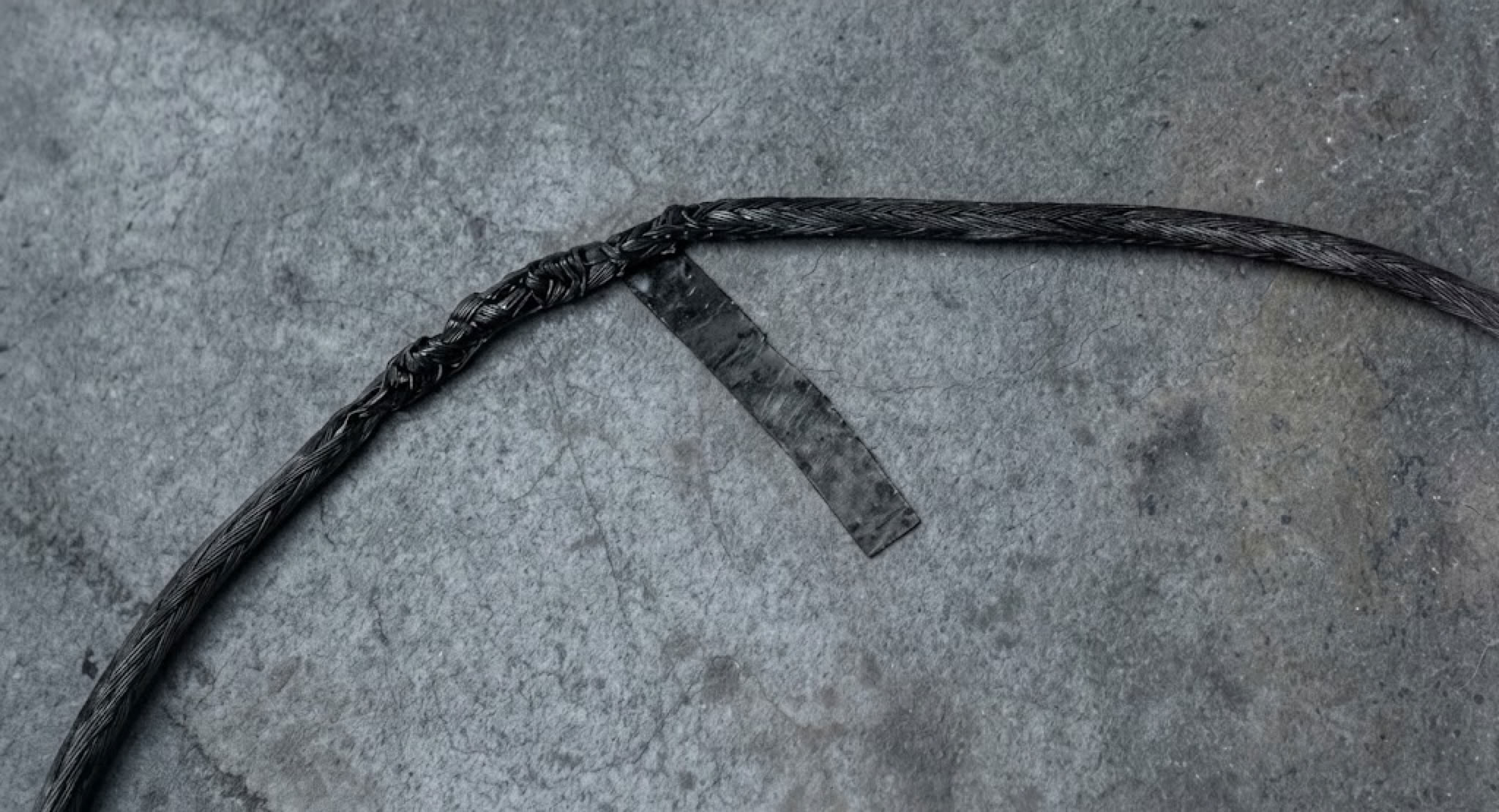
Bare electrical wires are also a shock hazard. Inspect electrical cords and tools to make sure they are in good condition. The extension cord shown has been damaged and must not be used until it is repaired properly.
Keep electrical wires and extension cords off wet surfaces. Do not use electric tools or handle live extension cords while standing on wet floors. Never operate several electrical devices from a single extension cord.
This may overload the extension cord, causing it to overheat and melt from excessive current flow. Never operate high-current devices, such as air compressors or welders, through extension cords. Instead, plug these devises directly into the proper wall outlet.
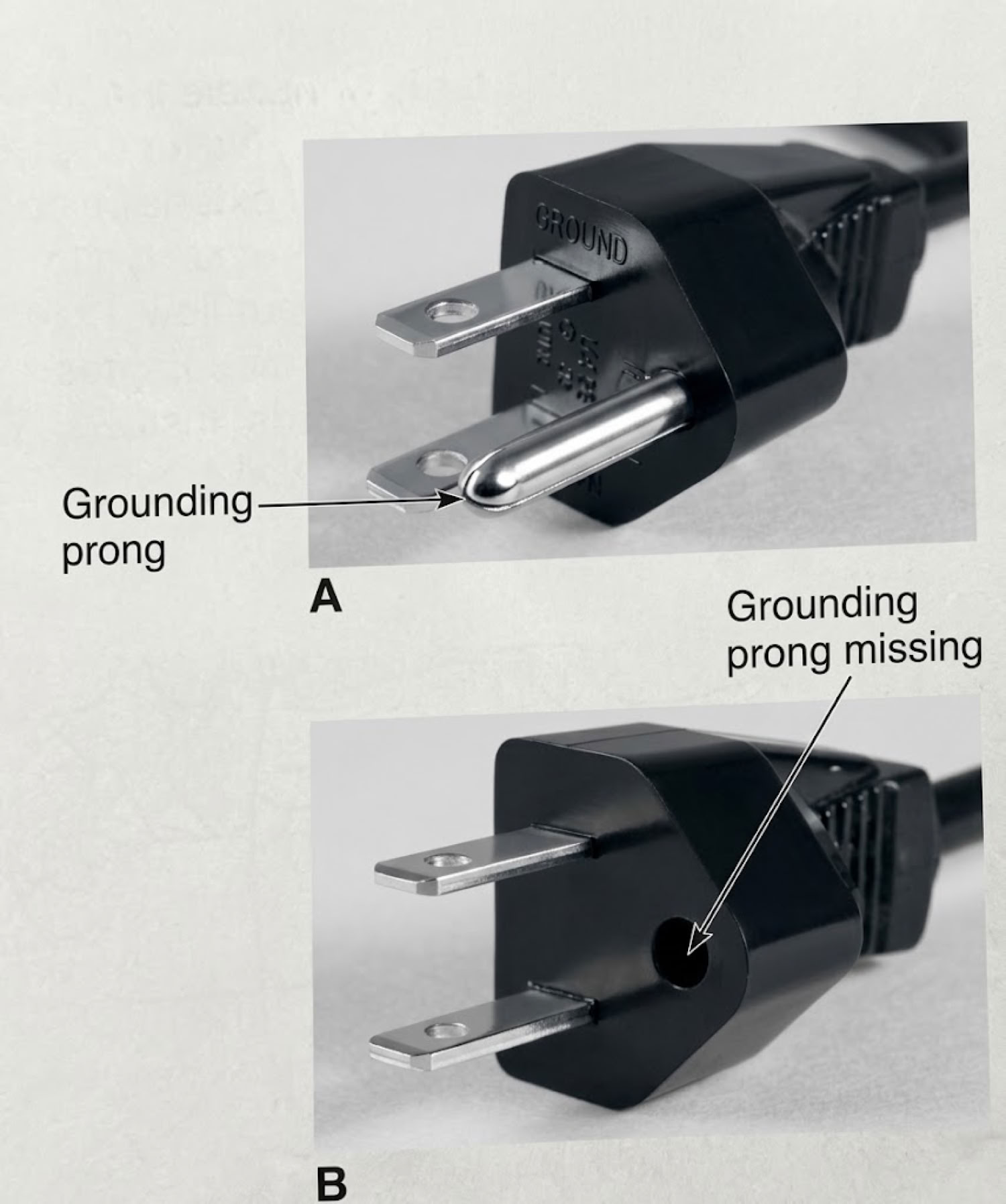
Make sure electric tools are properly grounded before use. If the tool is equipped with a grounded plug, make sure the third prong is intact.An automotive battery releases hydrogen gas, which is an explosion hazard.
A spark or flame could ignite this gas. If, for example, you accidentally short the positive terminal of the battery to ground, you will create a spark that could ignite the hydrogen gas.Hybrid vehicles also pose electrical hazards.
A hybrid vehicle has a gasoline-powered engine and a battery-powered electric motor/generator. A portion of the hybrid vehicle's electrical system operates on extremely high voltage.This is where the electrocution hazard is lurking.
Removing or switching off the high-voltage disconnect will prevent current flow through the high-voltage system. The location of the battery disconnect safety switch and the disconnect procedure will vary from one application to another, so refer to your owner's manual or service literature for the specifics.
The high-voltage cables are orange in color to warn of danger. Some high-voltage components in the power train may not have the orange warning coloration.The technician must be specially trained before working on hybrid vehicles.
To avoid electrocution, the technician should wear approved rubber insulated lineman's gloves (insulation value of 1000 V or more) with leather outer gloves and remove any metal jewelry when working on or near live high-voltage circuits in a hybrid vehicle.
The leather helps prevent catching a rubber glove on sharp sheet metal parts or frayed wiring, possibly puncturing the rubber. A nonconductive pull hook should be available to separate an unconscious person from a source of electrical current.
Noise Hazards
Collision repair shops can be noisy places to work. A collision repair shop will have at least a moderate level of noise at all times. When tools such as air chisels or impact wrenches are used, the noise can be deafening.
The pounding sound waves produced by loud noises can damage eardrums. Damaged eardrums will gradually but permanently lose the ability to distinguish sounds.
Injury Hazards
Cuts, burns, and sprains are common collision repair shop injuries. Collision repair technicians work with sharp metal, such as the edges of steel replacement parts and sheet metal torn during impact.
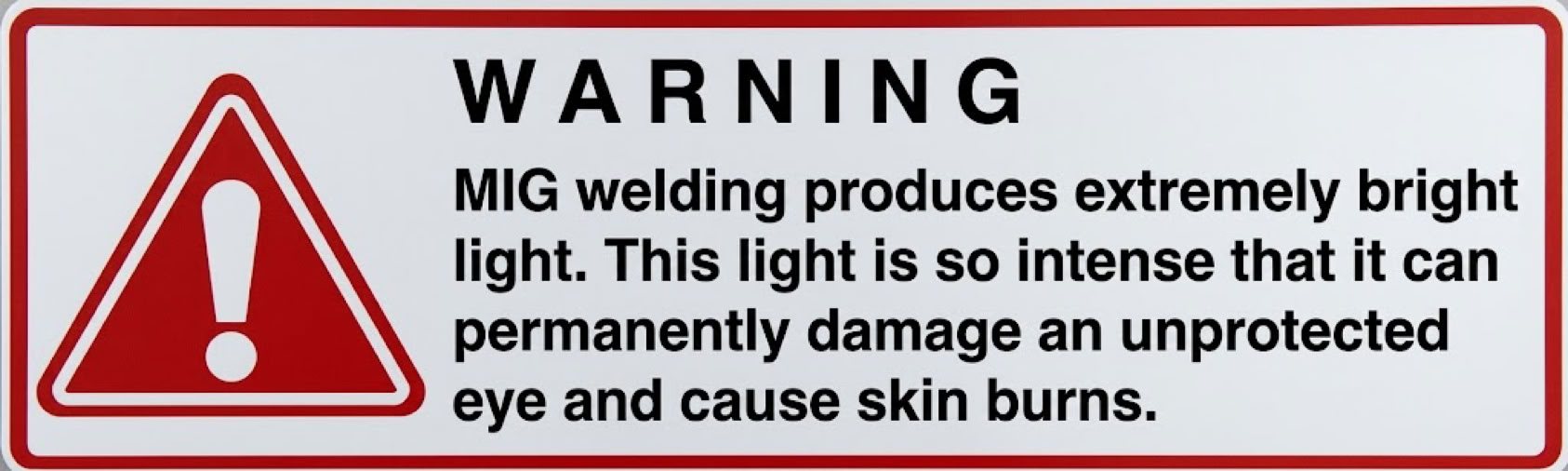
The sharp edges can cut a technician. A deep cut may require stitches to close the wound. All cuts are subject to bacterial infection.Burns can result from careless welding. The intense light produced during MIG welding can cause first-degree burns to unprotected skin and retina damage to unprotected eyes.
Sparks and slag from welding can cause second-degree burns on unprotected skin.Muscle sprains can be caused by slipping or falling on slippery surfaces. Oil and antifreeze spills can make the floor extremely slippery and should be cleaned up immediately.
Once the absorbent has soaked up the liquid, sweep up the absorbent and dispose of it in an appropriate container.The technician can trip and fall over tools and parts on the shop floor. Keep tools in a toolbox rather than allowing them to be scattered about the work area.
Find a separate storage place for the damaged parts removed from each vehicle. Stack the parts neatly so they are out of the way. The damaged parts should be kept until the vehicle is returned to the customer.Grinding and cutting generate small pieces of steel, aluminum, plastic, or other materials that can be thrown toward your skin and eyes.
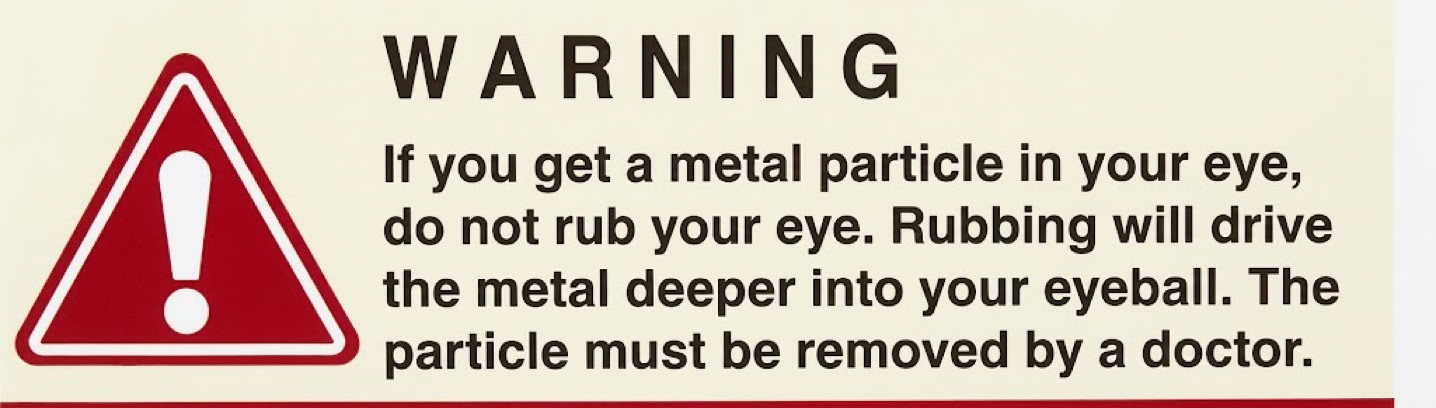
Unprotected eyes are particularly vulnerable to injury during grinding and cutting operations.Even a very small piece of debris that gets into your eye can cause irritation, infection, and even loss of vision.
Collision technicians are often required to work under raised vehicles. Vehicles can be safely raised on a lift or they can be raised with a floor jack and placed on jack stands. Never crawl under a vehicle that is supported only by a floor jack or any other type of jack. The jack could inadvertently release, allowing the vehicle to fall on you.
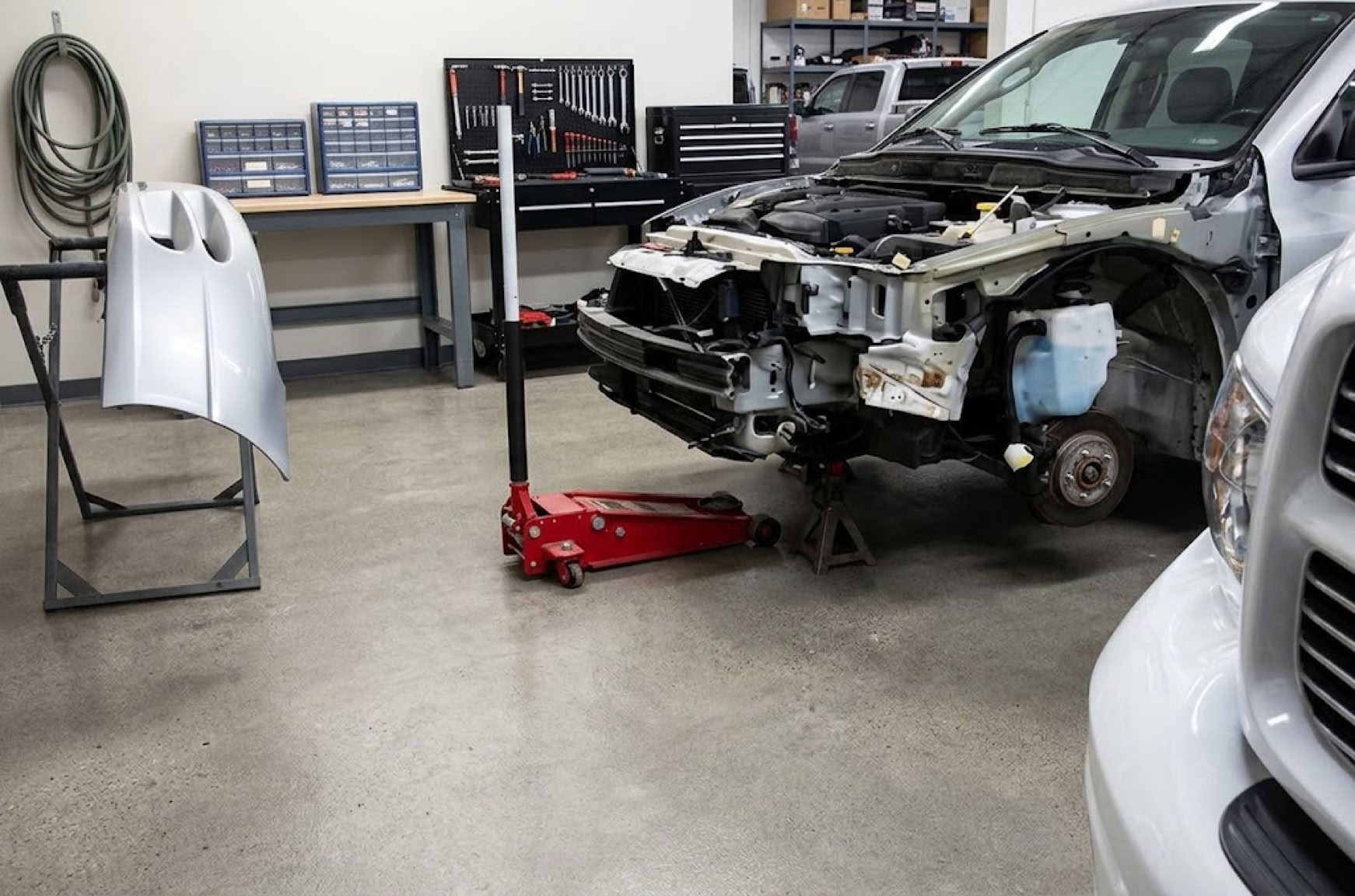
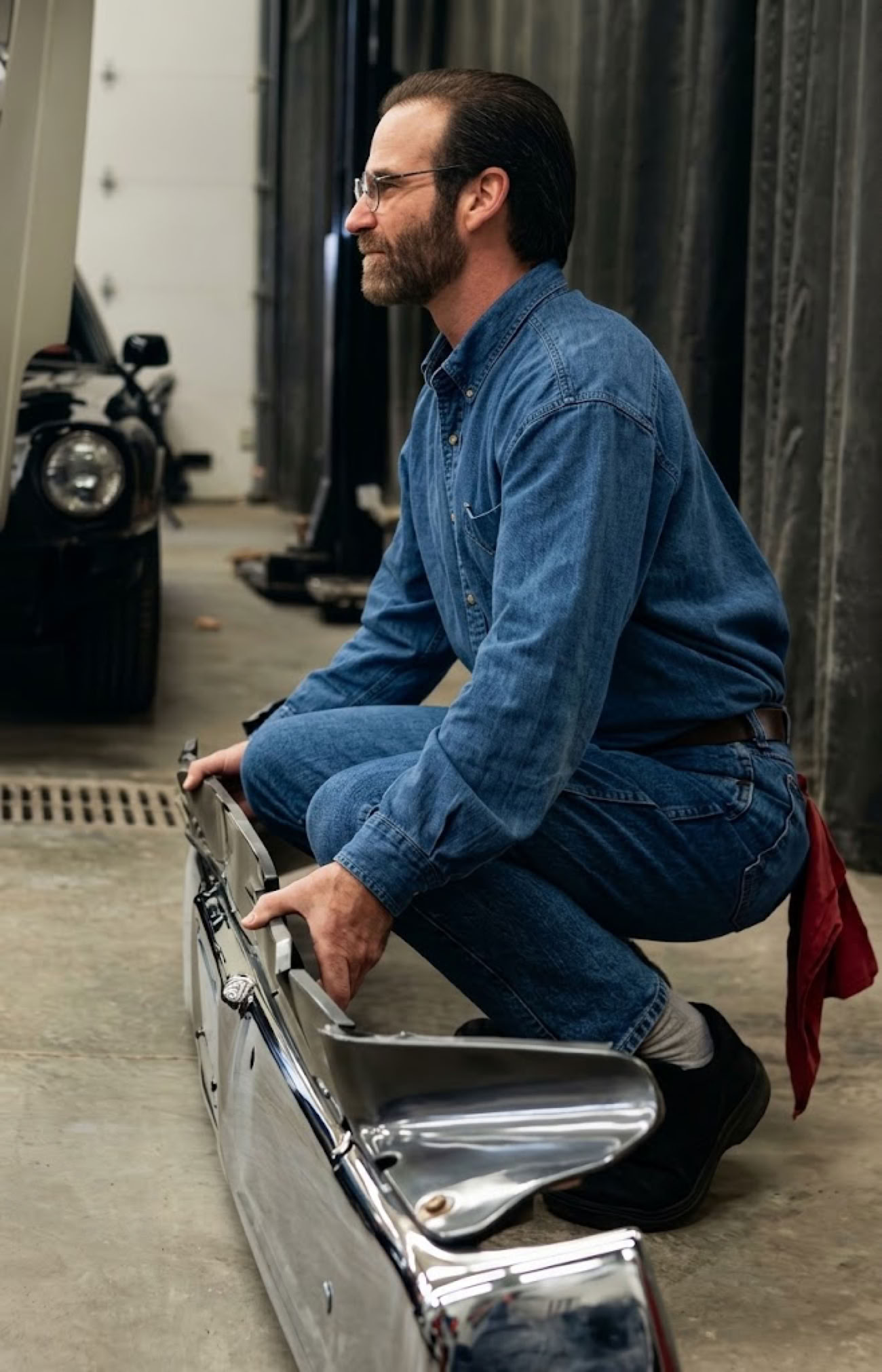
Improper lifting or trying to lift something that is too heavy may cause back muscle strain, disc damage, or inflammation.Many replacement parts, such as bumper assemblies, doors, and hoods, are heavy.
These parts must be lifted and held in place during installation. Improper lifting can lead to injury.The Image shows the proper way to lift a heavy object.
Do not bend your back. Instead, bend your knees and use your legs to lift the object. There is a limit to the amount of weight a person can lift. Know your limitations.
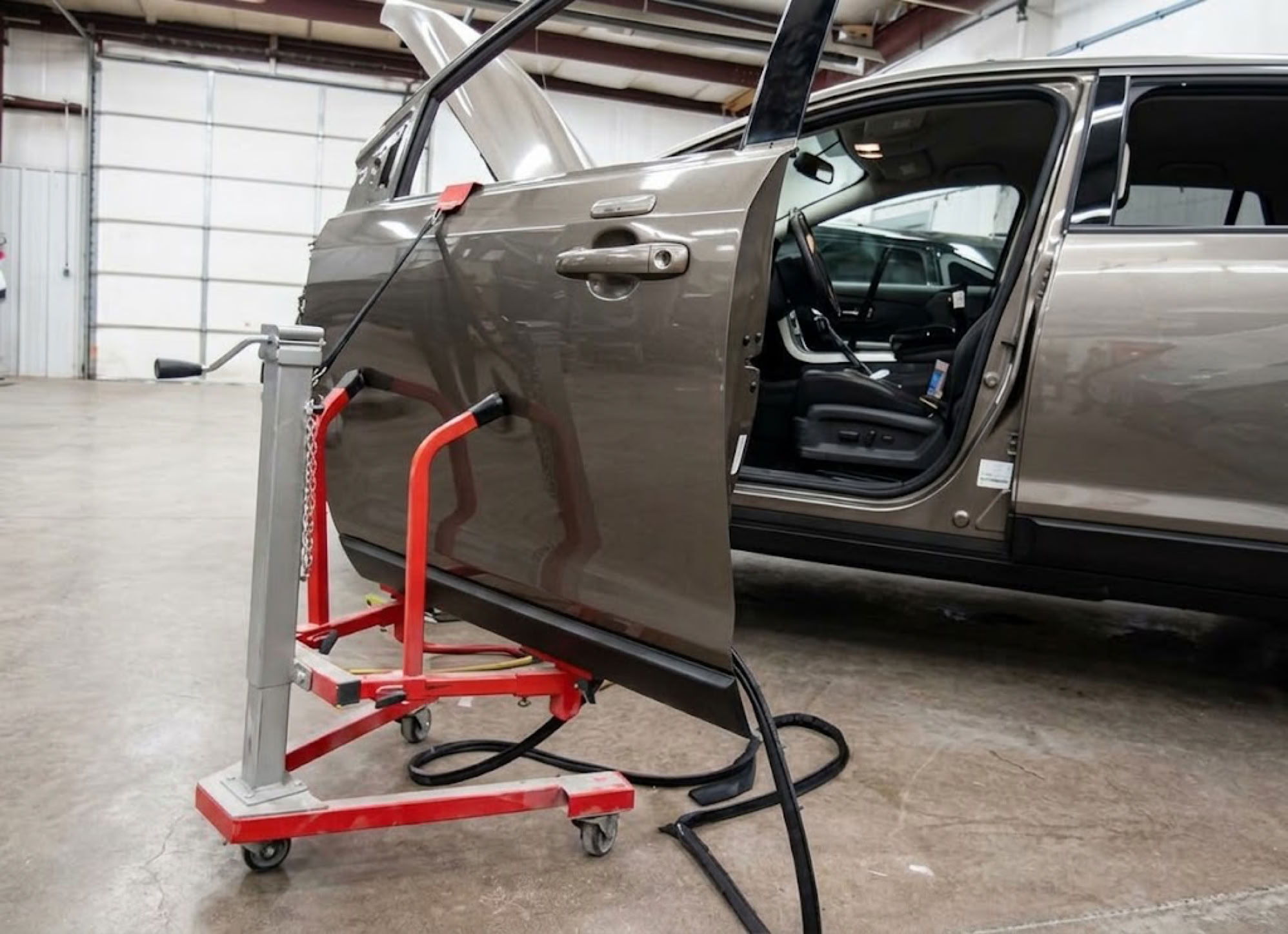
Whenever possible, get help lifting heavy objects. A floor jack can be used to raise and position a bumper assembly. Special devices are available to raise, lower, and position doors.
To prevent injury, never use your hands, feet, knees, or elbows to strike an object when attempting to move or align a part.
Instead, use a proper tool. For example, you could use your elbow to open a stuck tailgate. However, hitting the tailgate with a rubber hammer will eliminate the chance of injury.
Repetitive stress injury is the inflammation of muscles or tendons caused by performing the same action again and again. Swelling of the inflamed area may affect nerves, causing pain or numbness.
A repetitive stress injury can also occur when a muscle or a group of muscles is contracted for an extended period of time. This contraction, or shortening, of the muscle pulls on the tendons the muscle is attached to, causing inflammation.
Vibration can also contribute to repetitive stress injury. In a collision repair shop, this vibration could come from hand block sanding for long periods or continuous use of an air chisel. Common types of repetitive stress injuries are carpal tunnel syndrome and tendonitis.
To avoid repetitive stress injury, do not perform a specific task for an extended period. When hand block sanding, change body position occasionally so the same muscles are not kept contracted for extended periods of time.
Do not use an air chisel continuously. Take a break every 15 minutes or whenever you feel pain or numbness in your arms. Improve your posture when working at a computer and take time to stretch.A vehicle's air bags can deploy with deadly force.
Safety must be a primary concern when working on or near air bag system components. Disable the air bag system before servicing the steering wheel, dashboard, or other areas where the system parts are located.
Always follow the directions in the service manual for the specific vehicle being serviced. When carrying an undeployed (live) air bag module, point the module away from your body. Set an undeployed air bag module face up.
ersonal Protective Gear
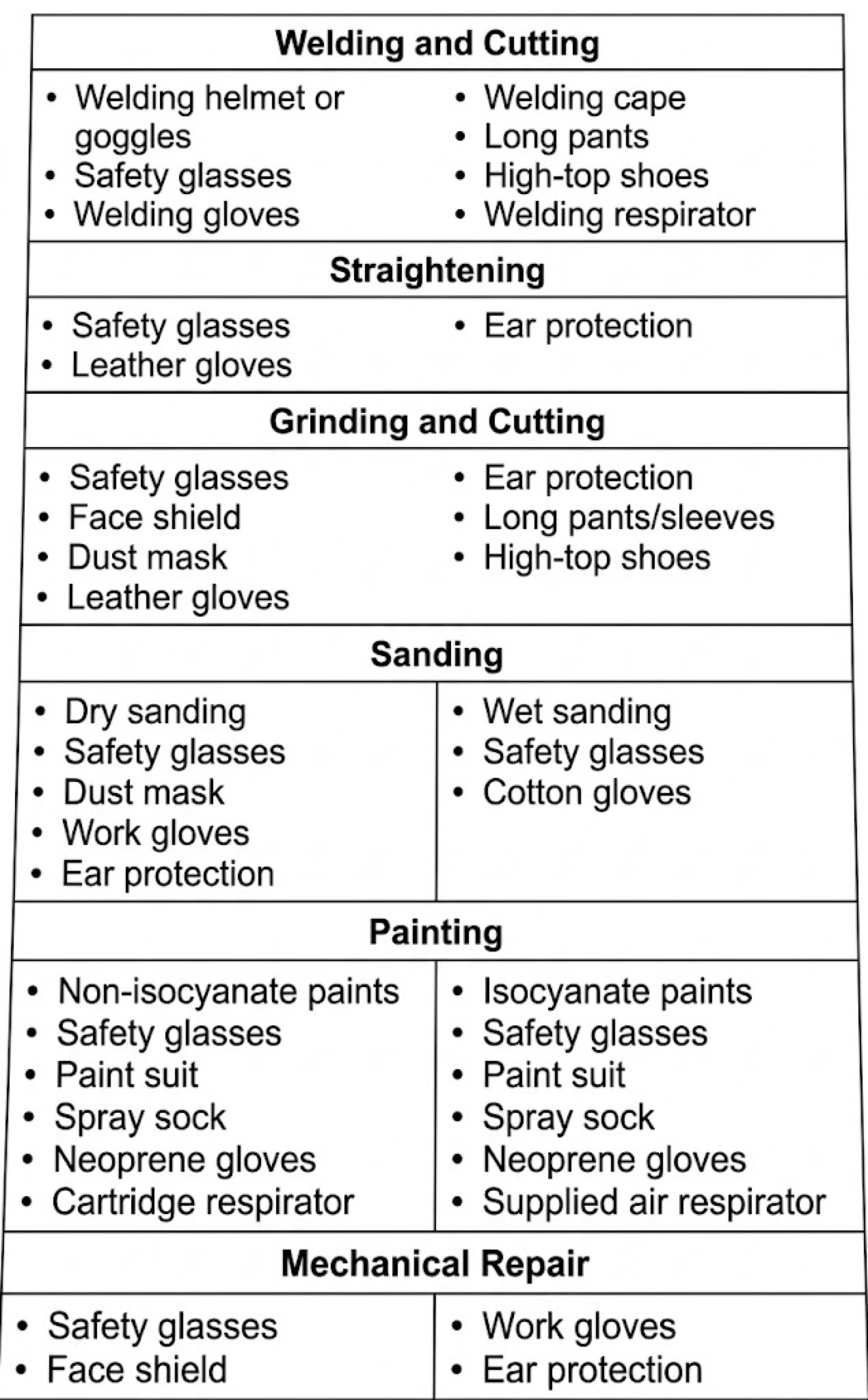
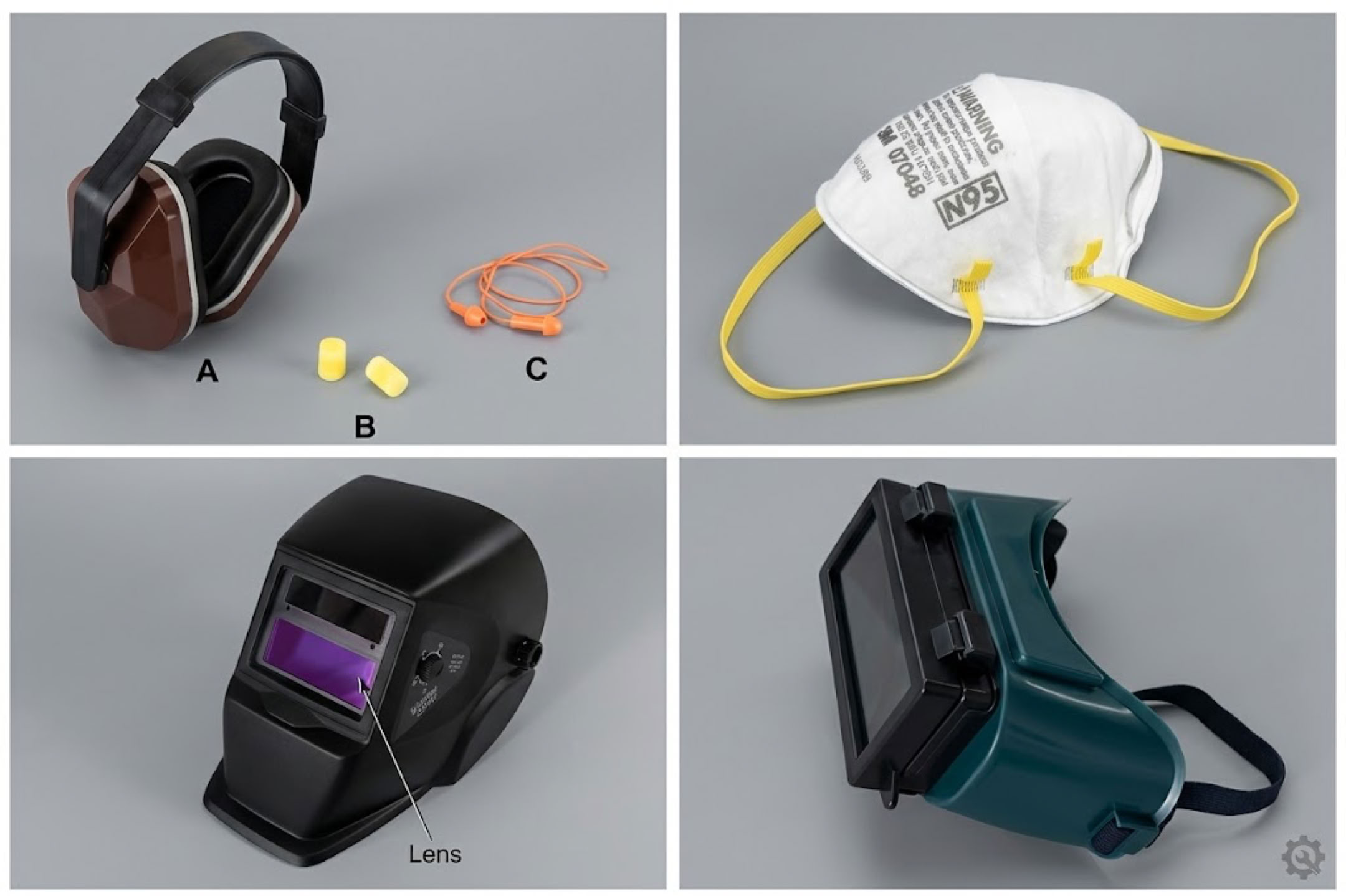
This section describes the various types of personal safety equipment that should be used when working in the collision repair shop. The appropriate safety equipment for various collision repair tasks is summarized in the image.
Eye Protection
Eyes are vulnerable to particles thrown through the air when grinding or cutting, liquids splashed when mixing paint, and intense light generated when welding. Eye protection must be a concern for every collision repair technician and shop visitor.
Safety glasses, protect the eyes from most particles and liquids. The lenses used in safety glasses are rated according to their impact resistance. Both basic and high-impact lenses are available. Safety glasses may have small side shields for protection from side impacts.
Safety glasses should be worn so they fit tightly against the forehead. Even when properly worn, safety glasses cannot protect against all particles and liquids. These harmful substances may be able to get around the glasses.
Safety goggles, fit tightly around the eyes. Goggles are not as comfortable as safety glasses, and they often fog up. However, goggles do provide superior eye protection against particles and liquids.
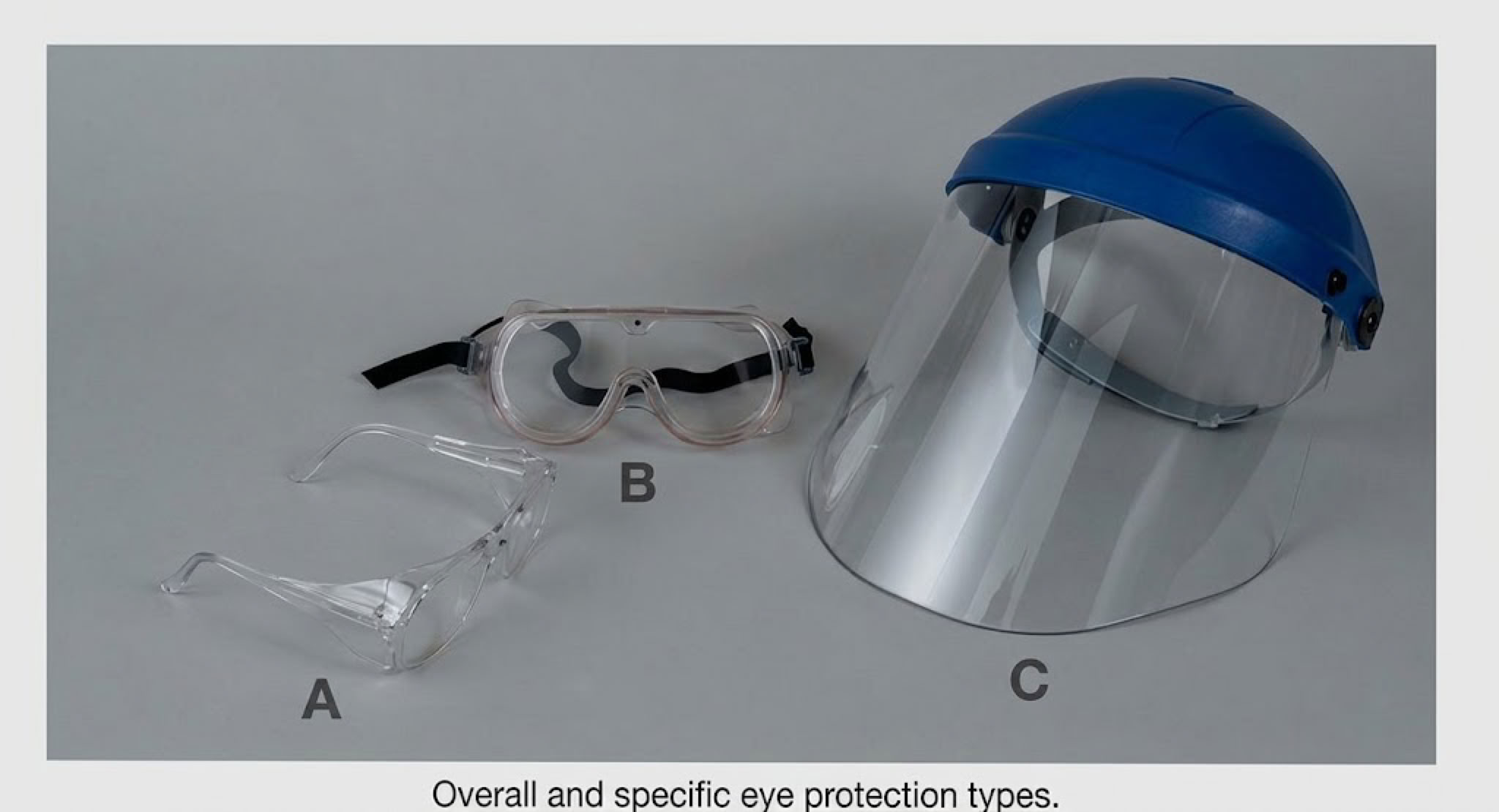
A face shield, shown in the image protects the entire face, not just the eyes. However, because the face shield does not fit tightly against the face, contaminants may be able to get around the shield.
Therefore, safety glasses should be worn with a face shield.Never rub or scratch your eyes with a contaminated glove or sleeve. This could deposit metal particles or liquids in your eyes, negating the safety effect of eye protection.
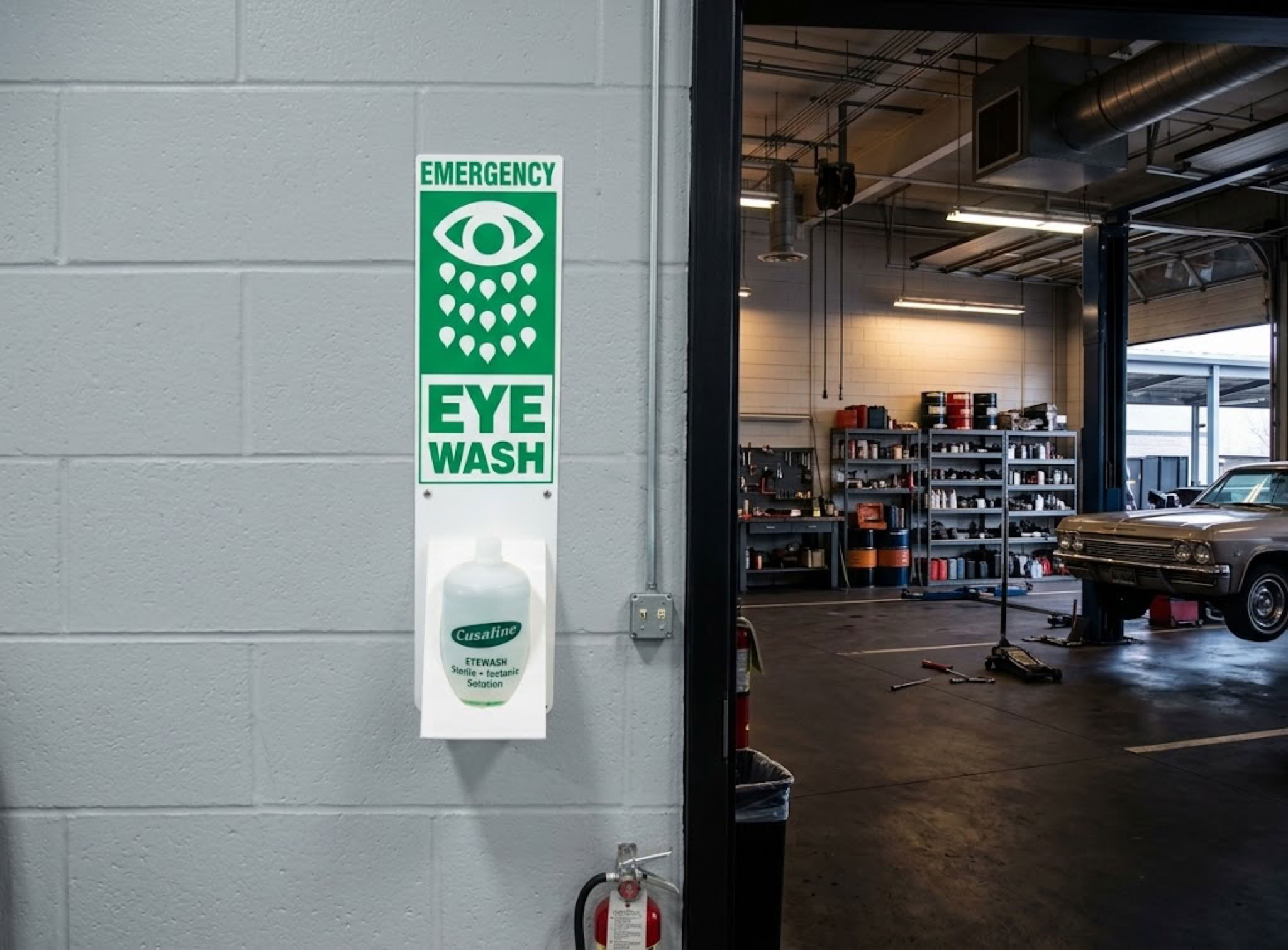
If you do get liquids or particles in your eyes, rinse the contaminants from your eyes at an eyewash station. Some eyewash stations provide a stream of fresh water to help rinse contaminants from your eyes.
Other stations, such as the one shown in the image, contain a bottle of sterile rinsing solution. Be sure you know how to use the eyewash station before you need it.In addition to the hazards from metal particles and liquids, intense light from welding can harm the eye.
Eye damage may not be apparent during welding. In fact, the effect may be delayed a few hours. Eye damage can lead to a loss of vision.To protect the eyes from the light of an oxyacetylene torch, wear welding goggles or a tinted face shield.
Arc welding produces a more intense light than an oxyacetylene torch. Wear an arc-welding helmet when arc welding. An arc-welding helmet, has highly tinted lenses to protect eyes from arc-welding light.
Ear Protection
A busy collision repair shop will be noisy and even deafening at times. Constant exposure to loud noises will lead to progressive hearing loss. Earmuffs and earplugs, dampen the sound waves acting on your eardrums, preventing hearing loss. You will still be able to hear when wearing ear protection, but the loud noises will not harm your eardrums.
Respiratory Protection
Sanding body filler and paint produces harmful dust. Breathing sanding dust will gradually damage a technician's lungs. A dust mask, must be worn when dry sanding. The dust mask will gradually become clogged with dust. Discard the mask when the outside of the mask looks dirty.
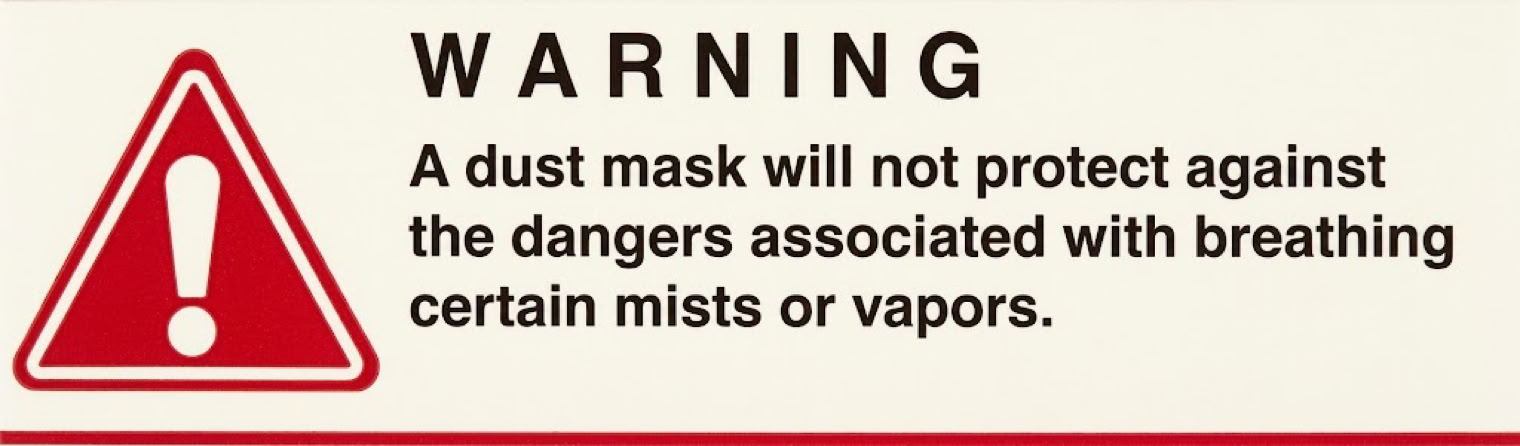
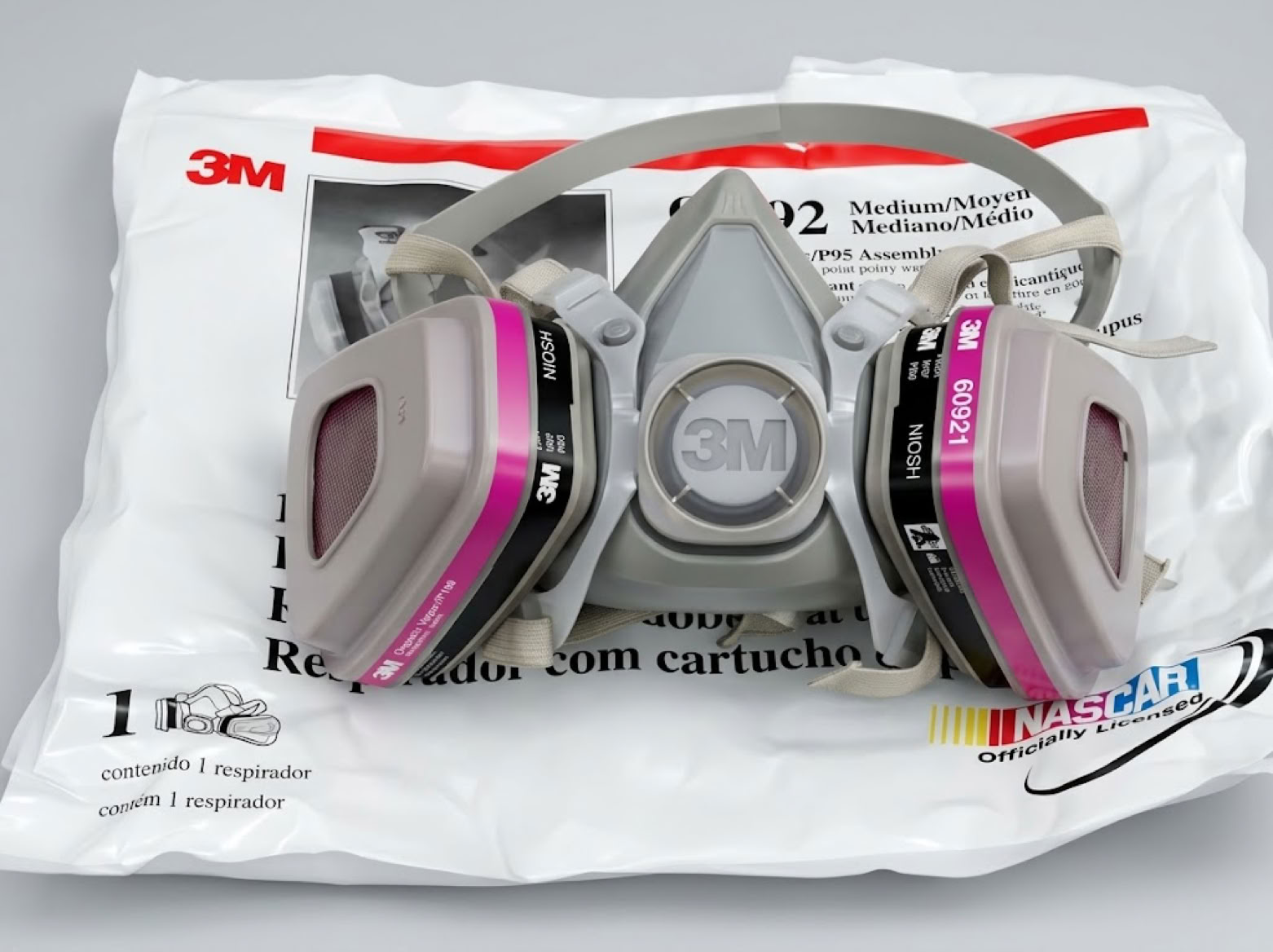
A respirator is designed to protect the lungs from harmful vapors and mists. When spraying or mixing paints that do not contain isocyanates, a technician can wear a cartridge-type respirator.
This type of respirator works only in well-ventilated areas
The cartridge-type respirator removes contaminants from the air the technician breathes. This type of respirator uses an activated carbon cartridge to absorb the harmful chemicals in paint vapor and mists.
The activated charcoal absorbs carbon-based (also called organic) chemicals in the breathing air. A prefilter on top of the activated carbon cartridge removes dust from the air.
Activated carbon cartridges must be replaced periodically. Useful service life depends on several variables, including the amount and type of contaminants in the air, the temperature and humidity in the work area, and the rate of airflow through the respirator.
Refer to the manufacturer's literature for specific recommendations.
A respirator should be cleaned after each use, especially if it is shared among technicians. Begin by removing the cartridges and any pre-filters from the respirator. Then disassemble the respirator, wash it with an approved cleaner or disinfectant, and rinse it in clean running water.
Some respirator manufacturers allow the inside of the respirator to be disinfected by wiping it with 70% isopropyl alcohol. After cleaning, dry the respirator with a clean cloth or allow it to air dry.
Then inspect all parts for distortion, wear, and deterioration; and reassemble the respirator. Finally, test the respirator to make sure that it is working correctly.
The activated carbon cartridges absorb chemicals whenever they are exposed to the air. Storing the respirator in an airtight bag prolongs the life of the cartridge.
The stored respirator should be positioned so that the face contact portion does not distort. If the face contact area is distorted, it will not seal properly.
A cartridge respirator cannot remove isocyanates from the air and should never be used when spraying isocyanate-containing paint.
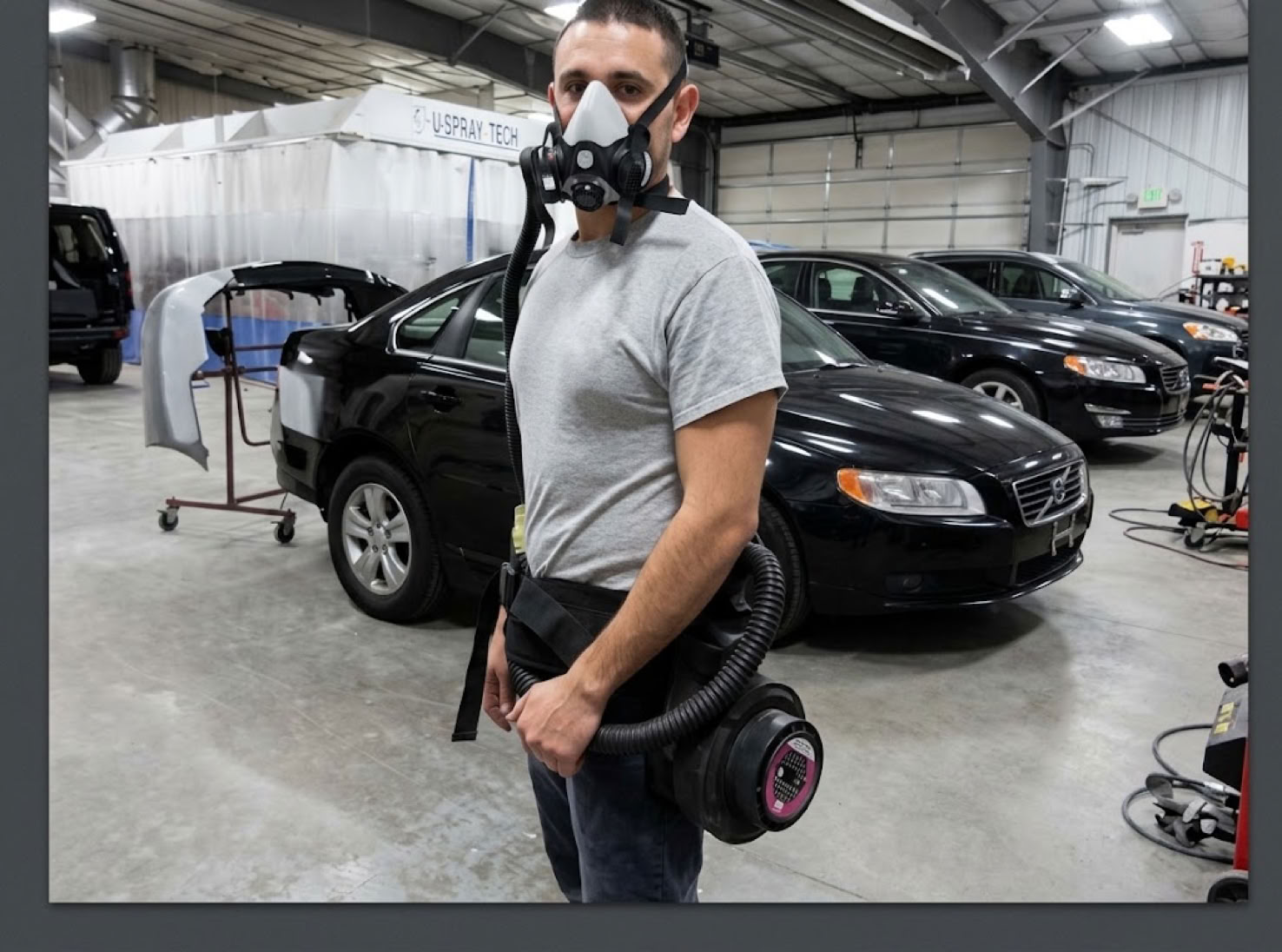
Therefore, a supplied-air respirator is required when spraying isocyanate-containing paint. A supplied-air respirator provides the technician with clean, safe air from outside the spray area.
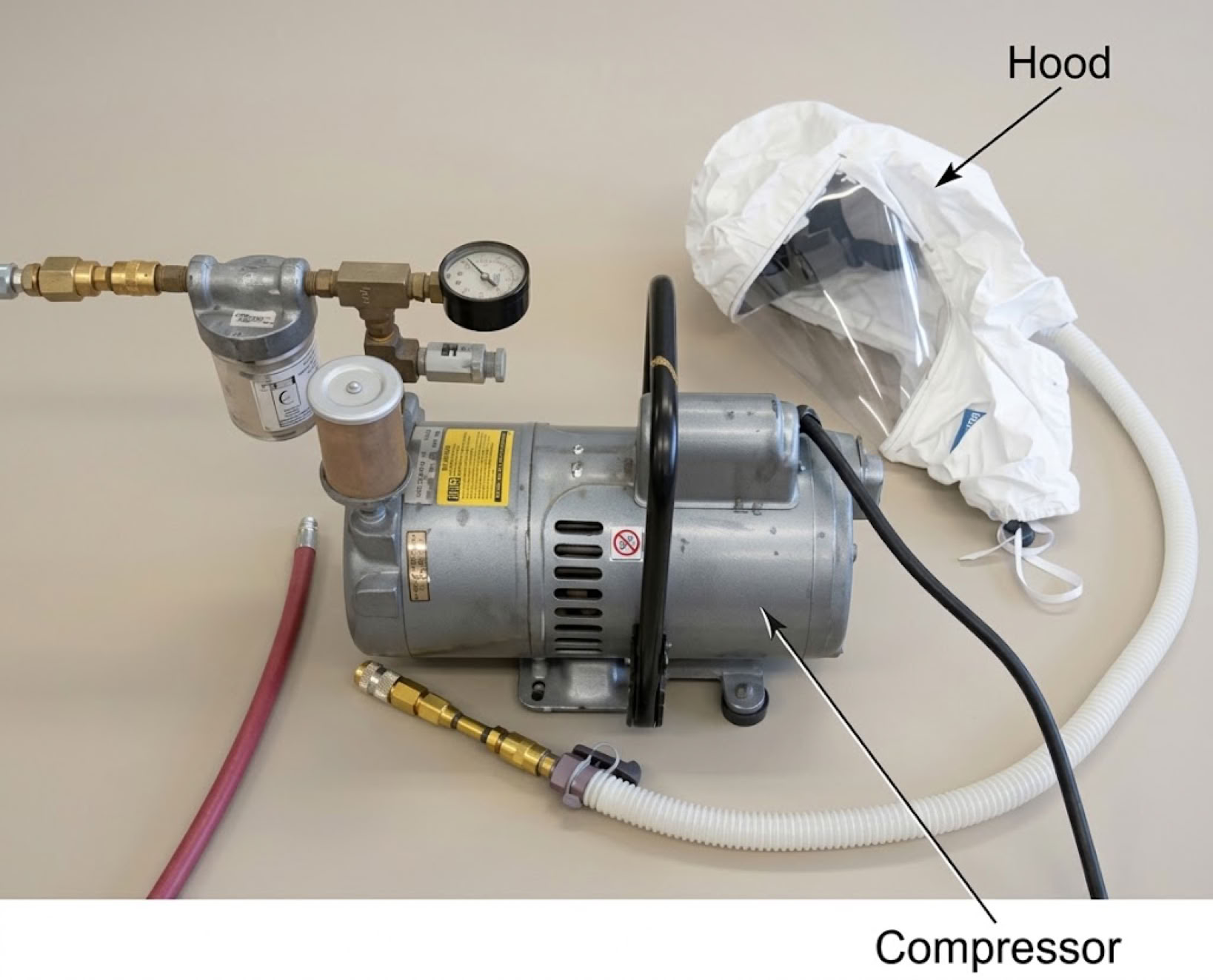
There are two types of supplied-air respirators. The first type uses filtered air from the compressed air line in the spray booth. To be used for both spraying and breathing, this air must pass through a series of filters that removes contaminants.
The compressor's air intake must be located in a fresh air area, away from spraying operations and vehicle exhaust. The air compressor used in this type of system must be carefully maintained. If the compressor overheats, carbon monoxide, a lethal gas, may be added to the compressed air.
One brand of supplied-air respirator uses this series of three filters: first, a water and 5-micron particle filter; then, an oil and 0.01-micron particle filter; and finally, an oil vapor, hydrocarbon, and odor filter. A special air line conducts the filtered, breathable compressed air to a hood or mask worn by the technician.
A hood covers the entire head, while a mask covers only the nose and mouth. Compressed air for the spray gun passes through the three filters and is then routed through a desiccant tank, which removes water vapor.
The second type of supplied-air respirator uses an oil-less air compressor to pump treated breathing air to a hood or mask.A separate compressor and line are used to supply the spray gun. The oil-less air compressor is positioned outside the spray area, so it can pull in clean air.
Skin Protection
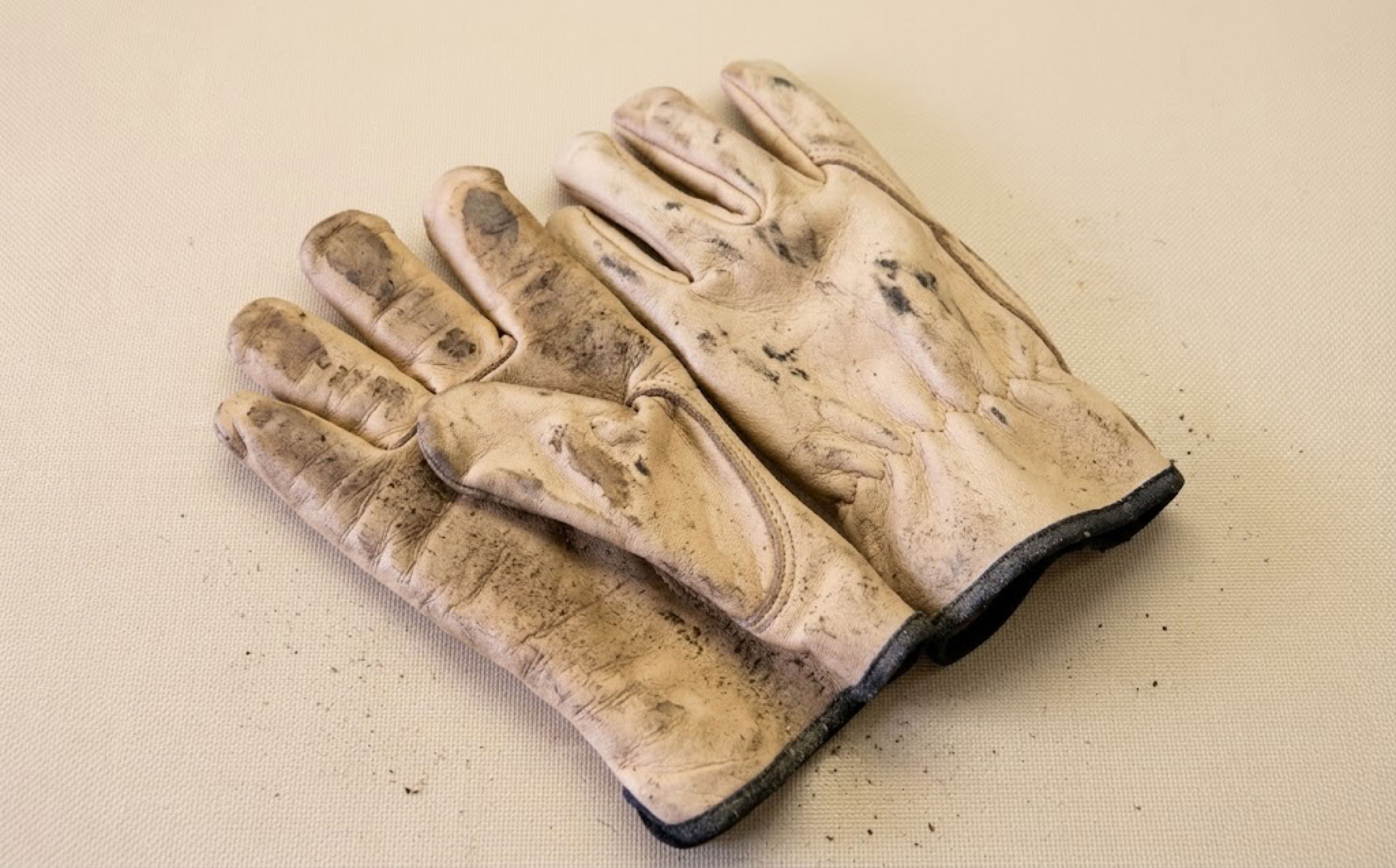
Cutting and grinding metal or working around sharp edges can lead to cuts and abrasions. Protect your skin by wearing leather gloves when grinding, cutting, or handling sharp materials.
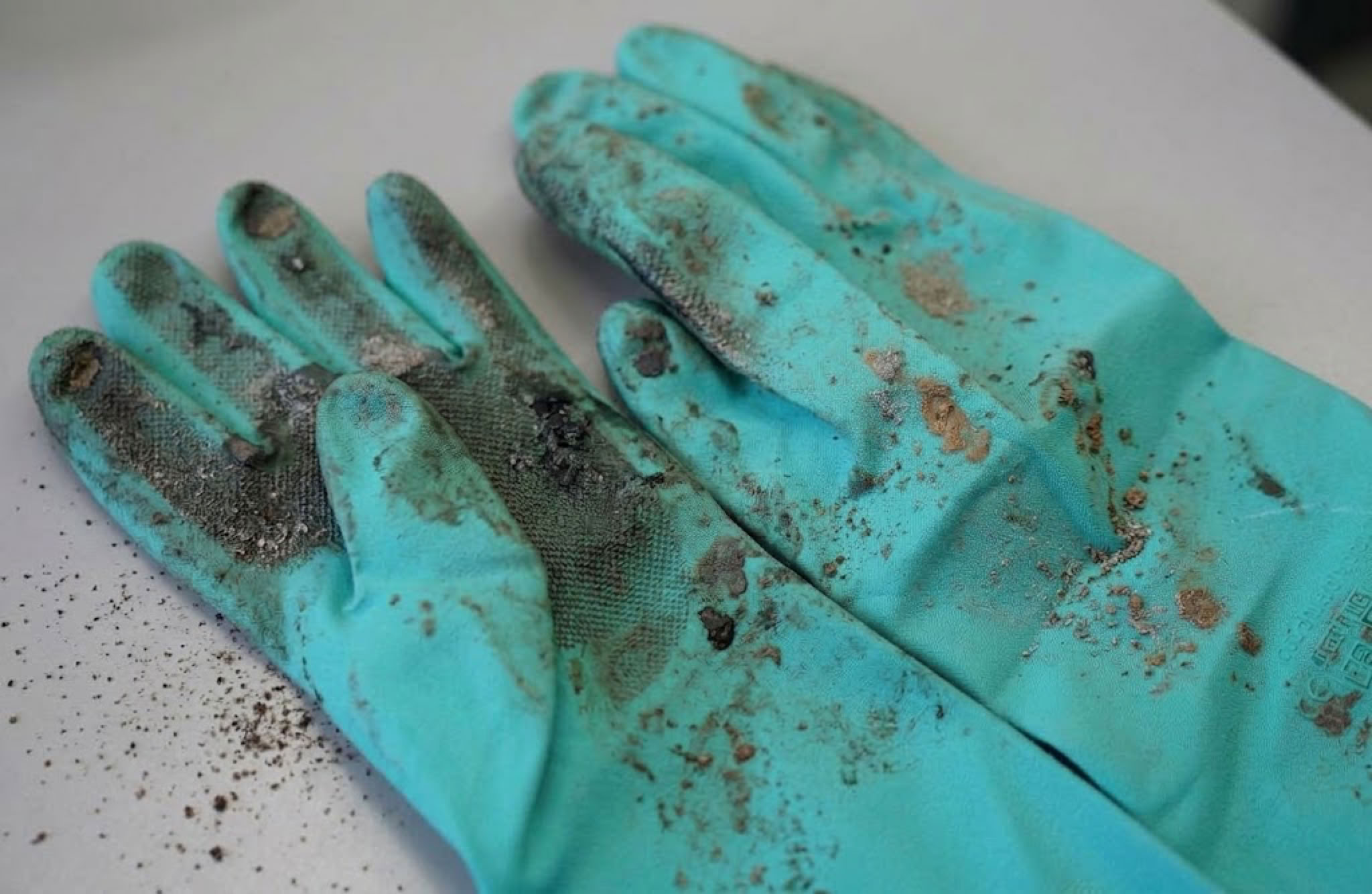
Harmful substances in paints and solvents can be absorbed through the skin. Neoprene gloves, protect the skin from harmful chemicals. Wear neoprene gloves when mixing or spraying paint, cleaning a spray gun, and handling solvents.
When painting, be sure to wear a paint suit and a spray sock. The paint suit is a one-piece garment that keeps the paint off your body. A spray sock is a hood that protects your head and neck.
NOTE
The protective clothing and equipment worn to help protect against the sparks and intense light encountered when welding are covered later in this chapter.
Steel-toed shoes protect feet from injury caused by falling objects. Similarly, a hard hat protects your head from falling objects.
Also, when you work under a vehicle that has been raised on a lift, the hard hat will prevent you from hurting your head if you bump into the catalytic converter or other obstruction under the vehicle.
Insulated lineman’s gloves must be worn when disconnecting the battery on hybrid or all-electric cars. These gloves deteriorate in 6 to 8 months by developing cracks. Always check lineman’s gloves for cracks before use.
Breathe into a glove to fill it with air. Close off the end of the glove and watch for air leaking at the fingers or palm. Do not use a cracked glove because it offers no protection from dangerous voltage.
Safe Work Practices
The following section describes safety practices associated with the specific tasks performed in the collision repair shop.
Following these practices will reduce the chances of accidents by eliminating or minimizing many of the hazards encountered in the shop. Always keep safety in mind when working in the collision repair shop.
Welding and Cutting Safety
MIG welding, resistance spot welding, plasma cutting, and flame cutting are the most common welding and cutting procedures performed in the collision repair shop. Welding and cutting produce sparks.
If these sparks are allowed to contact an unprotected vehicle, they can start a fire or pit paint and glass. If the sparks land on the technician, they can cause serious burns. Welding galvanized metal causes toxic zinc gas to be released.
When performing welding or cutting operations, the technician must be protected with the appropriate safety equipment. Typical protective clothing and equipment that should be used when welding and cutting include:
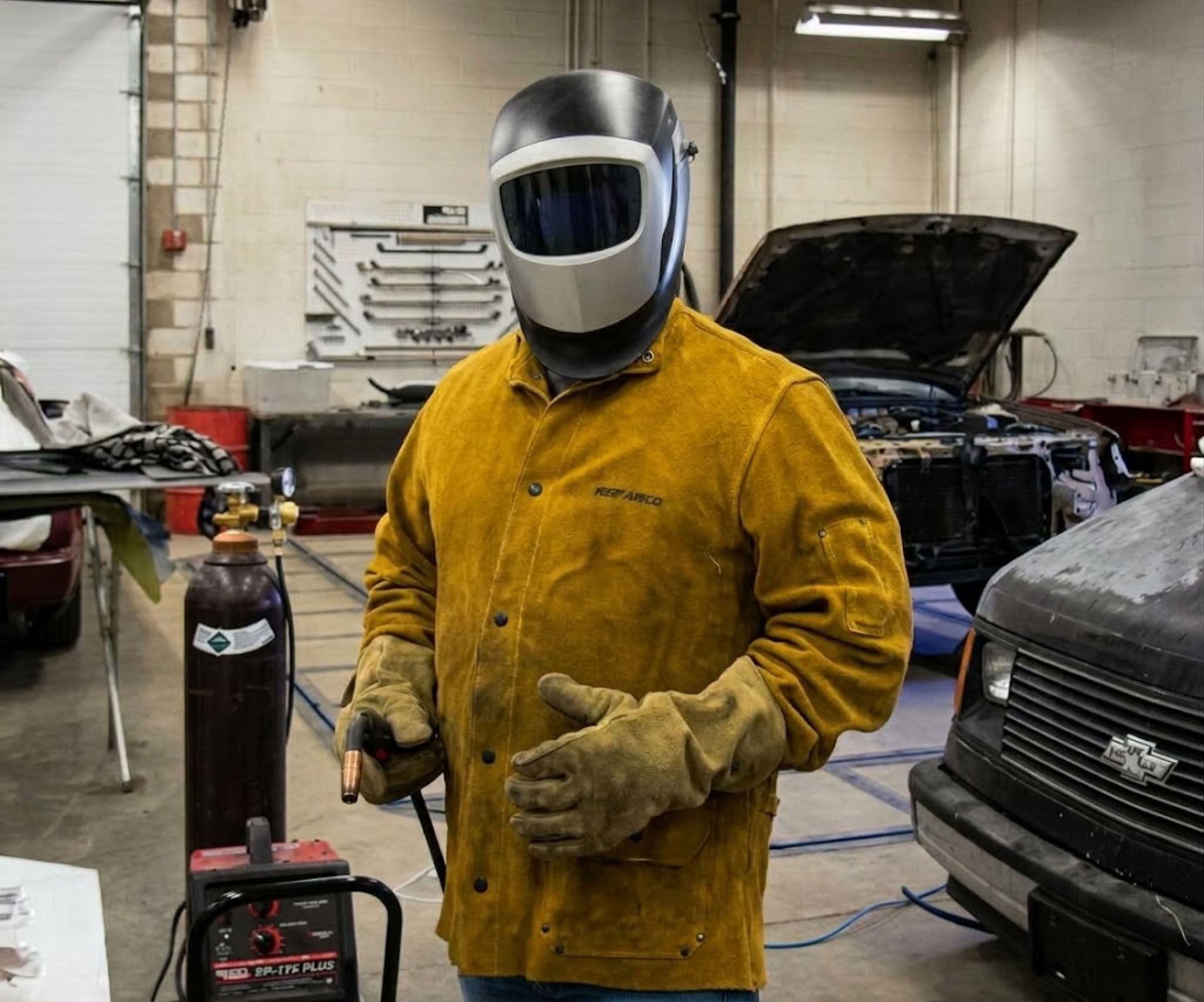
Welding helmet—A #10 shade will block the intense MIG welding light.
Welding goggles—Goggles with a tinted lens will protect your eyes from the bright light produced by an oxyacetylene torch.
Safety glasses—Safety glasses with side shields should be worn whenever a welding helmet or welding goggles are not required.
Welding gloves—Leather gloves will keep the sparks from burning the technician's hands and will prevent first-degree skin burns from the welding arc.
Welding cape—A cape keeps sparks off the skin and prevents sunburn from the welding arc.
Long pants—Long pants keep sparks off the skin and prevent sunburn from the welding arc.
High-top shoes—Sparks can land in low-cut shoes, causing burns. High-top shoes prevent this from happening. Also, always wear leather shoes or boots when welding. Canvas shoes will not provide adequate protection.
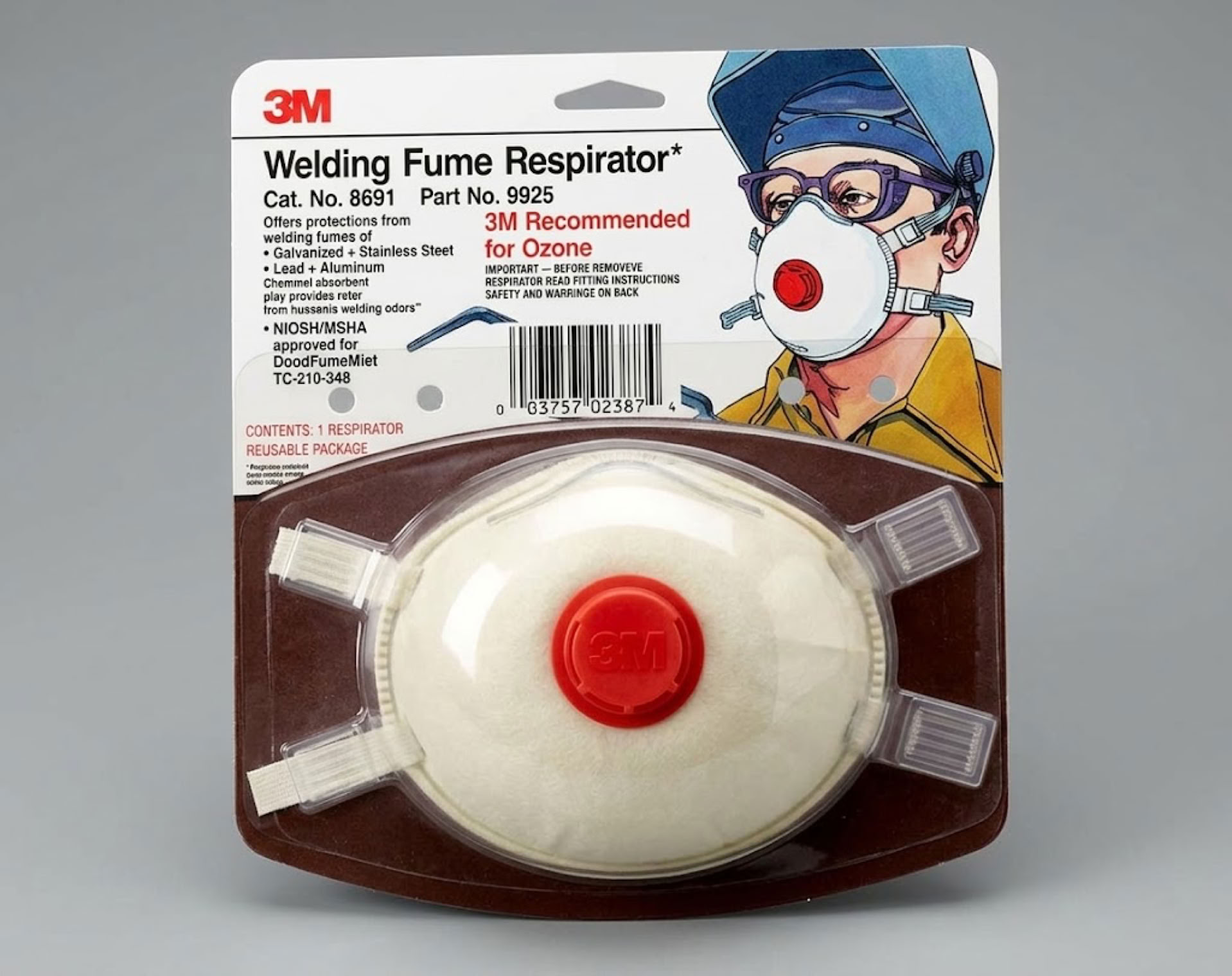
Welding respirator—A dedicated welding respirator protects the technician from harmful gases produced when welding.
Fan or air extraction—A fan will prevent the buildup of zinc gas when welding galvanized steel. Extractors often combine activated carbon with HEPA (High Efficiency Particle Air) filters to remove airborne particles and odors.
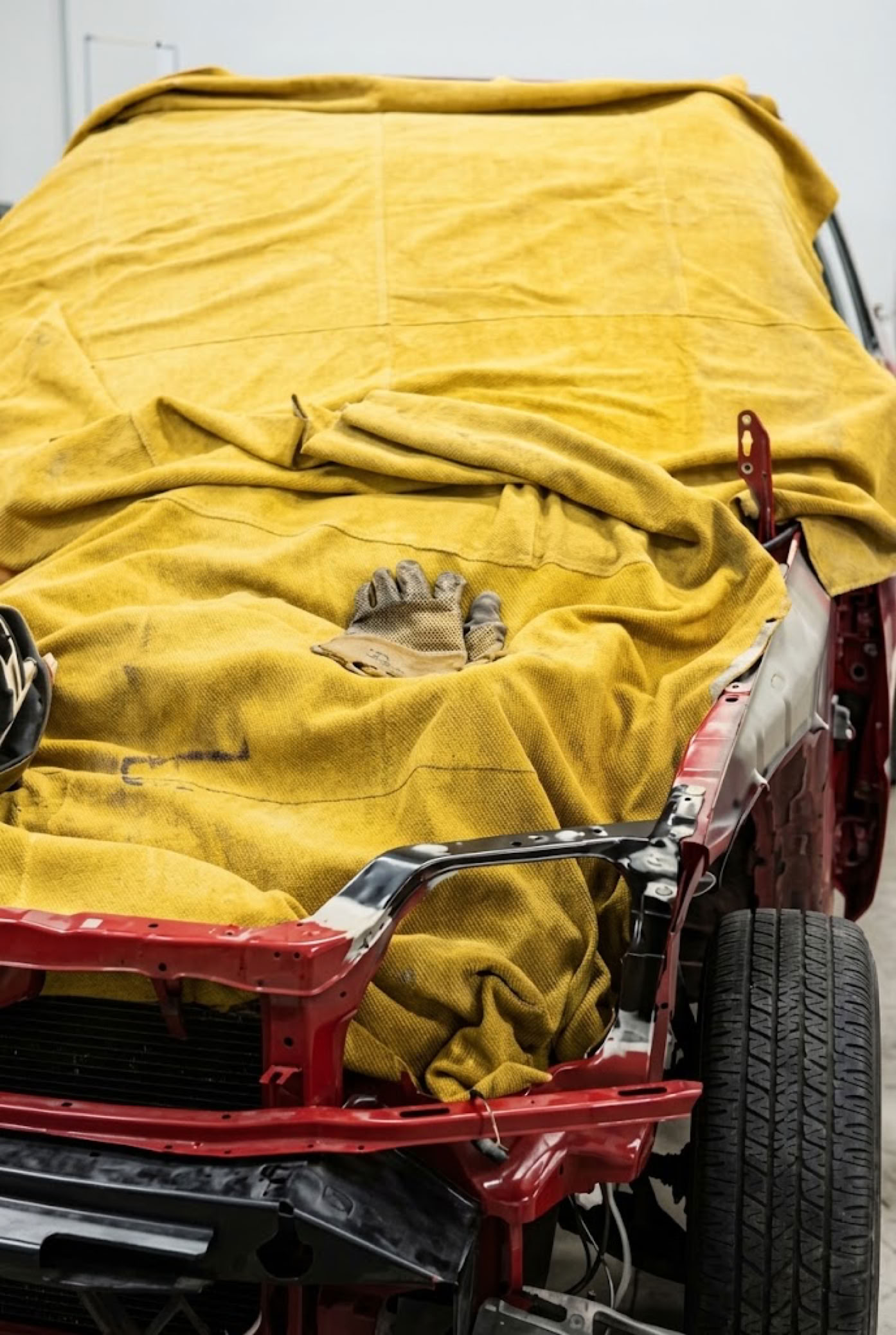
The vehicle being repaired should also be protected during the welding or cutting process. Take the necessary steps to protect the glass, paint, and upholstery. Drape a welding blanket over the vehicle to protect the area around the weld.
When using an electric welding or cutting process, disconnect the vehicle's negative battery cable. Electrical current passing through the vehicle's body can also travel through the vehicle's electrical system.
Disconnecting the negative battery cable will prevent this from occurring. Also, disconnect and remove the vehicle's computers. The current generated when welding may damage computers located in the weld area.
After removing a computer, protect it by placing it in a static-free bag and storing it in a clean, dry area. Look inside the panels to be welded for sound-deadening bags, insulation, or undercoating.
All these materials are flammable and must be removed before you begin welding or cutting. Never heat an object that contains gas or liquid. Heating a gas- or liquid-filled container, such as a bumper isolator, can cause an explosion.
Do not weld or cut near gas lines or rubber isolators. Remove these components before applying heat. Remove combustibles, such as masking paper, cardboard boxes, or thinner cans, from the work area before welding or cutting.
Set up a weld screen around the area to keep sparks from traveling. If applicable, make sure gas cylinders are chained or otherwise secured in place against a wall or on a cart. If a cylinder is knocked over, the valve could be damaged.
If the valve breaks, the gas inside the tank will be released. An oxygen tank is under about 2000 psi (13,800 kPa) of pressure. An acetylene tank is under about 250 psi (1724 kPa) of pressure.With either tank, the escaping gas could cause the cylinder to shoot across the shop with deadly force.
Stop all welding and cutting at least one hour before quitting time. If a weld is made just before quitting time and all workers leave the shop, combustibles inside or near the vehicle may be smoldering.
After several minutes, they may burst into flames. The fire, which could have been easily handled if the technicians were in the shop, could be disastrous.
After welding, always be on the lookout for smoke. Smoke is an indication that something is smoldering. Use compressed air from a blowgun or water from a hose to put out the smoldering material.
Many technicians keep an air hose and blowgun beside them when they are welding so they will be ready if a fire starts.
Straightening Equipment Safety
Tension is used to straighten damaged frames and sheet metal components. A straightening machine is a piece of tension-repair equipment that is capable of producing ten tons of force.
If released all at once, this force can cause serious injury or even death. A tension setup consists of a hookup, which is attached to the vehicle, a chain, and a pull source.
The chain is connected between the pull source and the damaged vehicle. The chain applies tension to pull out the damage. The hookup connects the chain to the damaged portion of the vehicle.
The hookup can be made with clamps, welds, frame wraps, or hooks. Any of these hookups can fail while the pull is being made.If the hookup fails, the chain may fly back toward the source of the pull.
The chain could hit anything or anyone in a direct line between the hookup and the pull source, causing damage or serious injury. Always alert everyone in the vicinity of the pull before tension is applied. Make sure everyone stands clear during the pulling process.
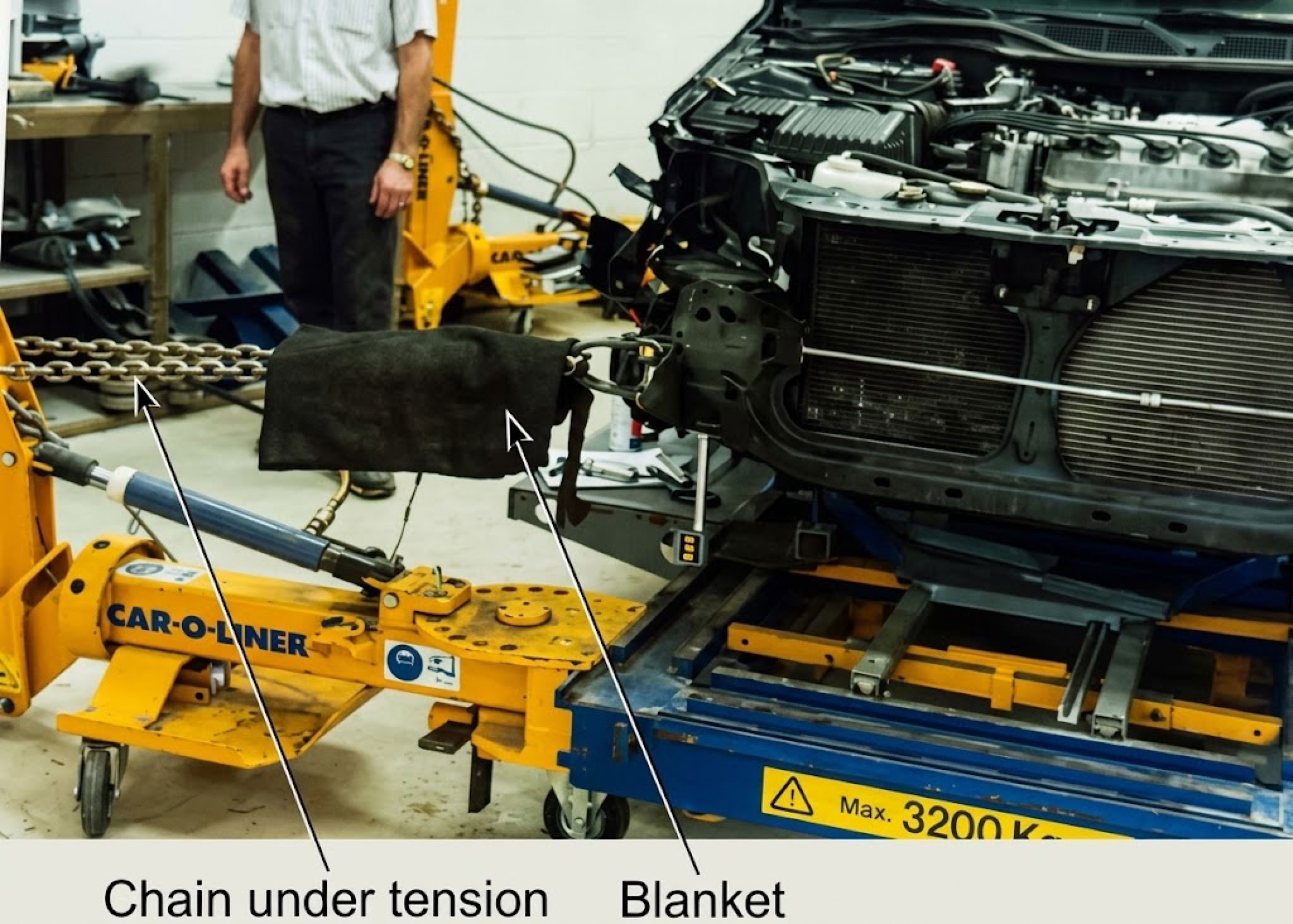
If you do not stop the pull, the extreme tension generated may cause something to break. Determine why the pull is not moving the damage and reposition the pull as necessary.Never stand beside or straddle a chain that is under tension.
The hookup may fail without warning. A proper hookup, which will be explained in later chapters, and a good chain will minimize the risk of a release.
During the pulling process, watch for movement in the vehicle as tension is applied. If the frame, the hookup, the vehicle, or the chain does not move, stop pulling immediately.

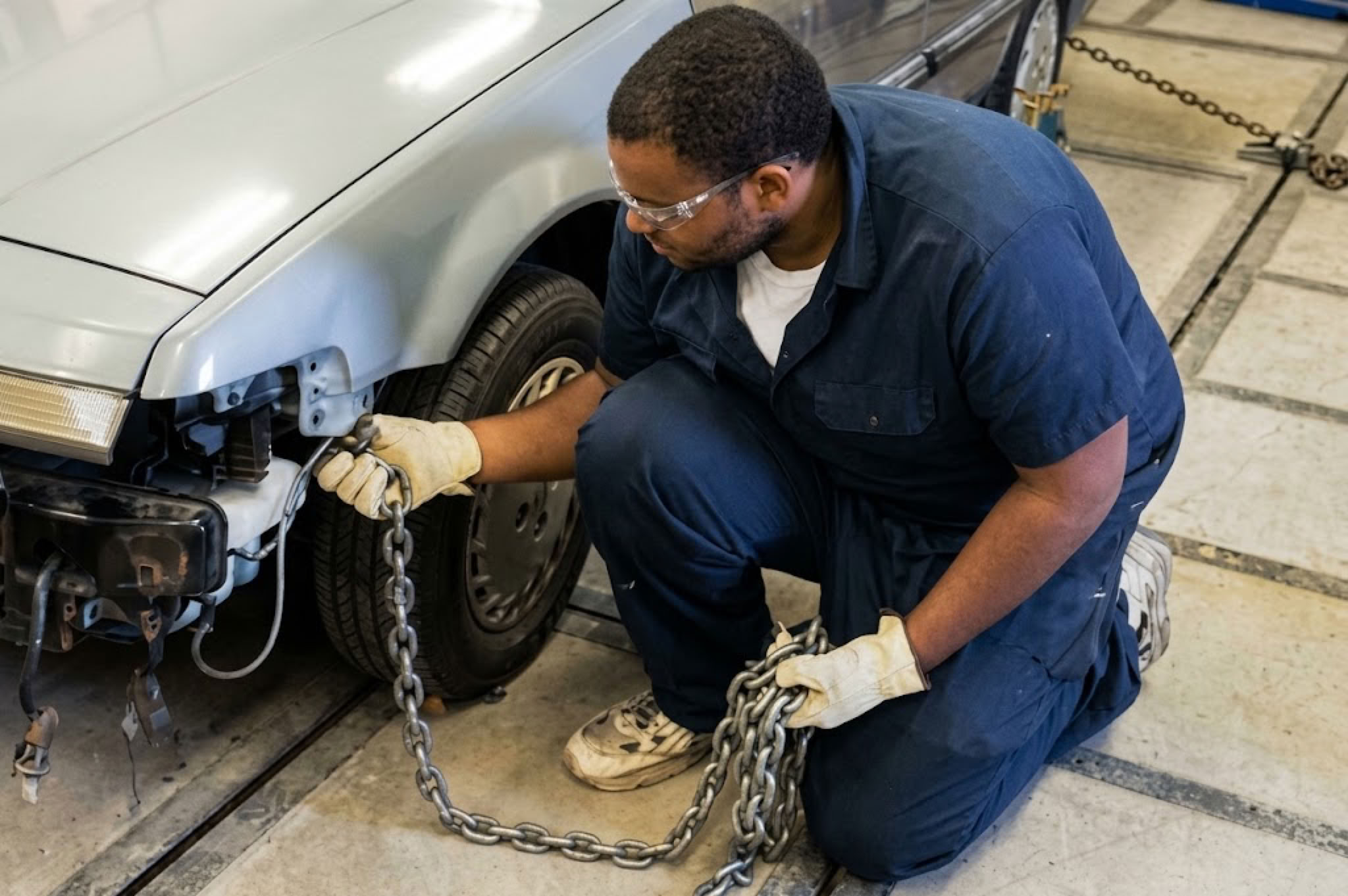
Always wear safety glasses and leather gloves when using straightening equipment. Add ear protection if there will be a lot of hammering on the vehicle.
Tension repairs require the use of many toolsReturn tools to their proper storage locations when you are done using them. Tools left on the floor or on the bed of the straightening machine may cause a technician to trip and fall.
Grinding and Cutting Safety
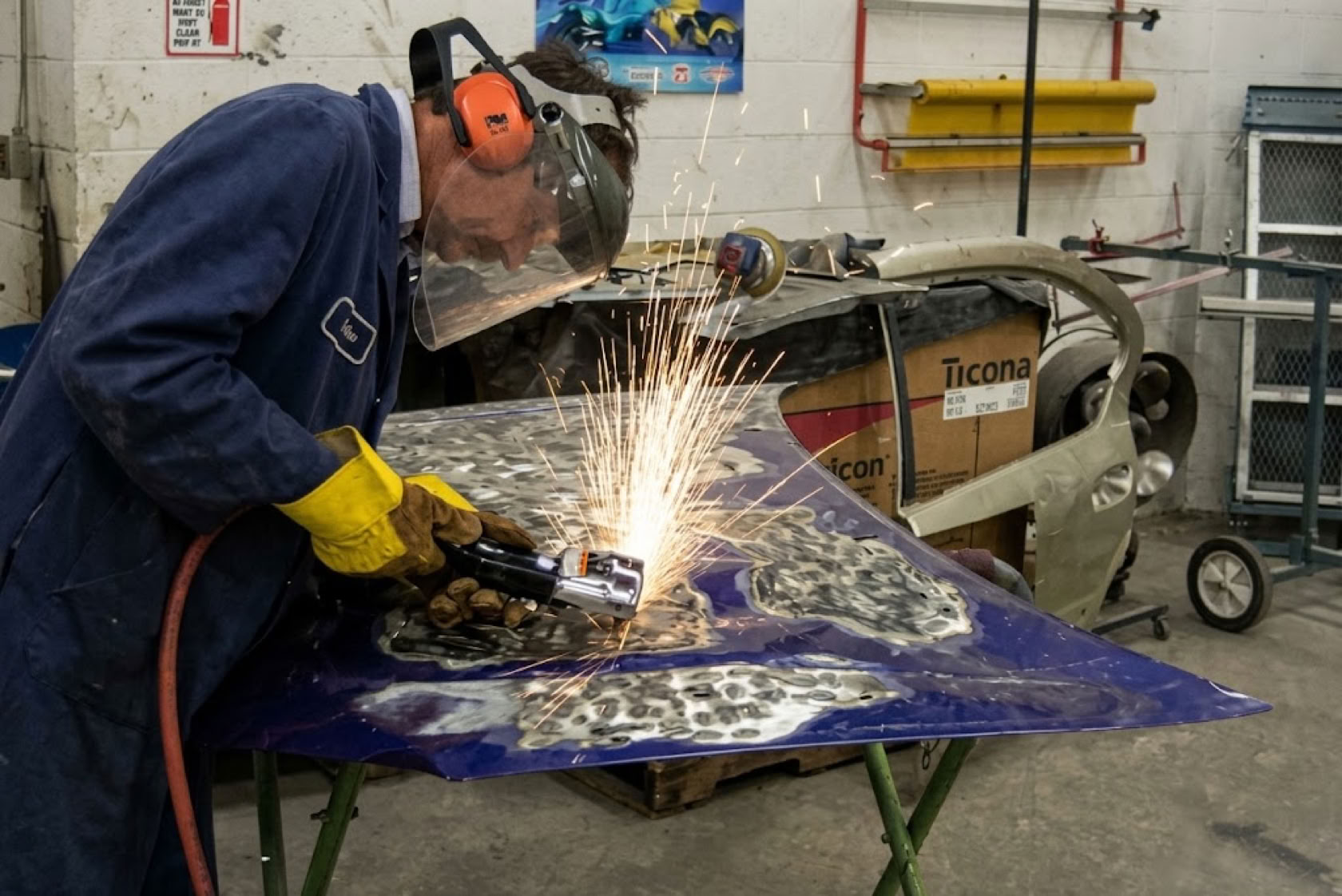
Specific safety procedures should be followed when grinding and cutting. Both grinding and cutting produce heat, noise, and sparks.
Grinding also creates dust. Cutting is done with a cut-off wheel or an air chisel, while grinding is done with a grinder.
Remove combustible materials from the work area before grinding or cutting. Sparks from cutting or grinding operations can cause pits in the paint, glass, or upholstery.
Protect these areas with a welding blanket or a piece of cardboard. Also, cardboard and duct tape can be used to prevent the grinder from accidentally hitting parts adjacent to the work surface.
To prevent damage and injury, know what is behind a panel before beginning any cutting operation. Grinding and cutting equipment can cut flesh as well as steel, so be careful.
The protective equipment that should be worn when grinding or cutting includes:
Safety glasses—These will keep metal shavings out of the eyes.
Face shield—The face shield will protect your face from sparks and metal particles.
Dust mask—If dust is produced during the process, a dust mask should be worn to protect the respiratory system.
Leather gloves—Slipping while grinding or cutting can force the tool against the technician's hand. Gloves will keep the grinding disk or cut-off wheel from biting into the skin.
Ear protection—Continued exposure to loud noises produced when grinding can cause gradual hearing loss. Ear protection will guard the eardrums from the shock of loud noise.
Long-sleeve shirts/long pants/high-top shoes—Sparks generated by grinding and cutting can cause burns on unprotected skin. Long-sleeve shirts, long pants, and high-top shoes will minimize the chance of burns.
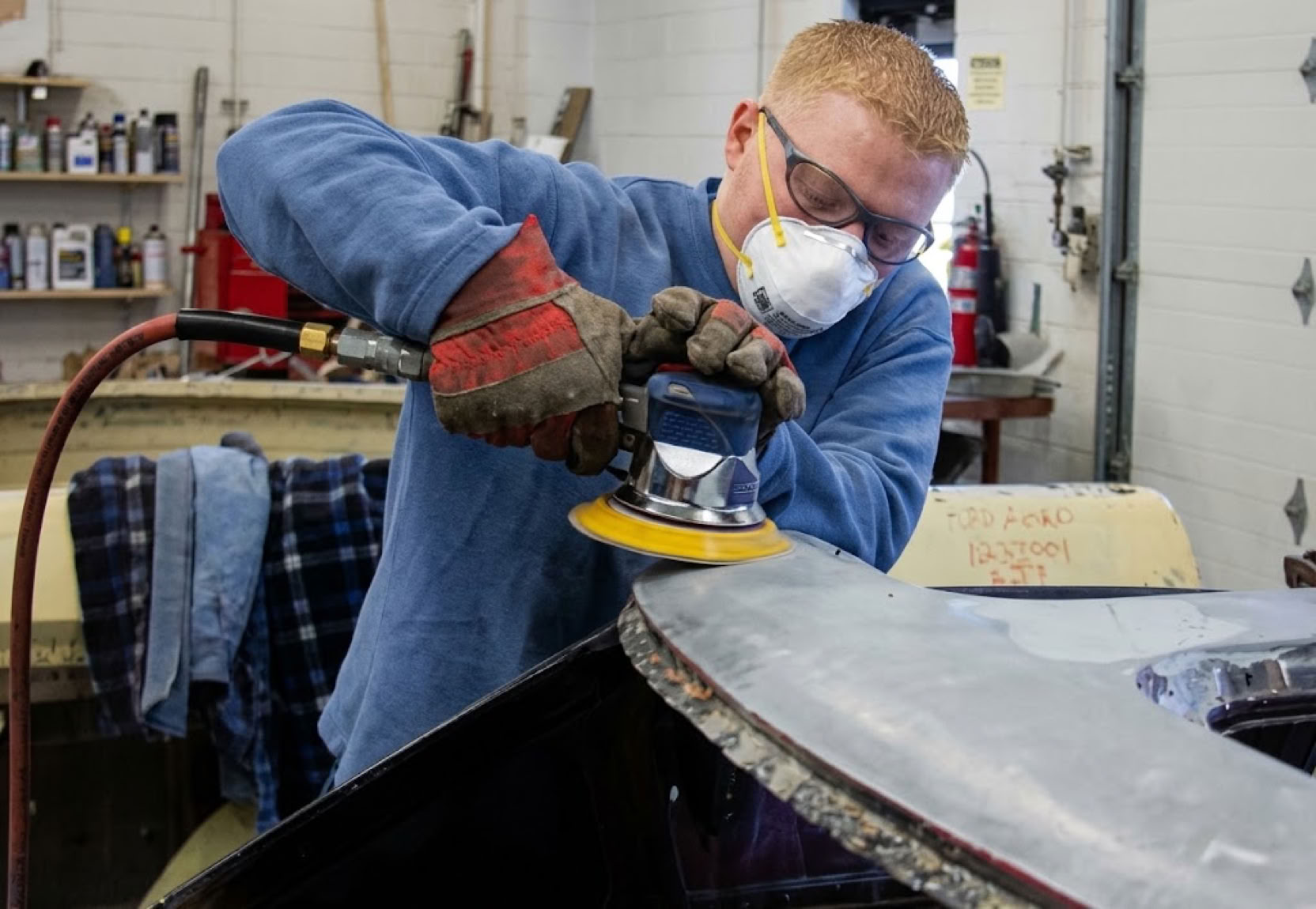
Dry sanding, which is done to level body filler and remove paint, produces dust. Inhaled dust particles are a health hazard.
Sanding Safety
A dust mask will protect a technician from dust particles. Dry sanding can be done by hand or with an air-powered sander.
The amount of dust produced by power sanding can be reduced if a vacuum system is used. The vacuum system pulls air and sanding dust away from the sanding area.
Wear safety glasses to protect your eyes from dust particles. Power sanding can be loud, so appropriate ear protection should be worn.
Rough sandpaper can injure the skin. Wear leather gloves if your hands directly contact the sandpaper. When sanding, cover adjacent vehicle surfaces to prevent damage.
Close the windows and doors to keep the dust out of the vehicle's interior. Wet sanding can be done by hand or with an air-powered sander.
Wet sanding does not produce dust like dry sanding. Water, which is used as a lubricant, tends to wash away sanding residue. Nevertheless, wet sanding can be hazardous.
Water from the wet sanding operation ends up on the floor. This causes the floor to be slick. Additionally, the wet floors pose a shock hazard. Never run electric cords over a wet floor.
Hand wet sanding with coarse sandpaper, such as 220-grit sandpaper, can wear away the skin on the fingertips. Wear gloves to protect the fingers when wet sanding by hand.
Painting Safety
Painting exposes the technician to several hazards. Even paints that do not contain isocyanates are hazardous due to organic solvents in paint.
With proper protection, a technician can enjoy a long and productive career in painting. Without adequate protection, the technician will eventually suffer health problems.
Protective gear that should be worn when working with non-isocyanate paint—paint without a hardener or catalyst.
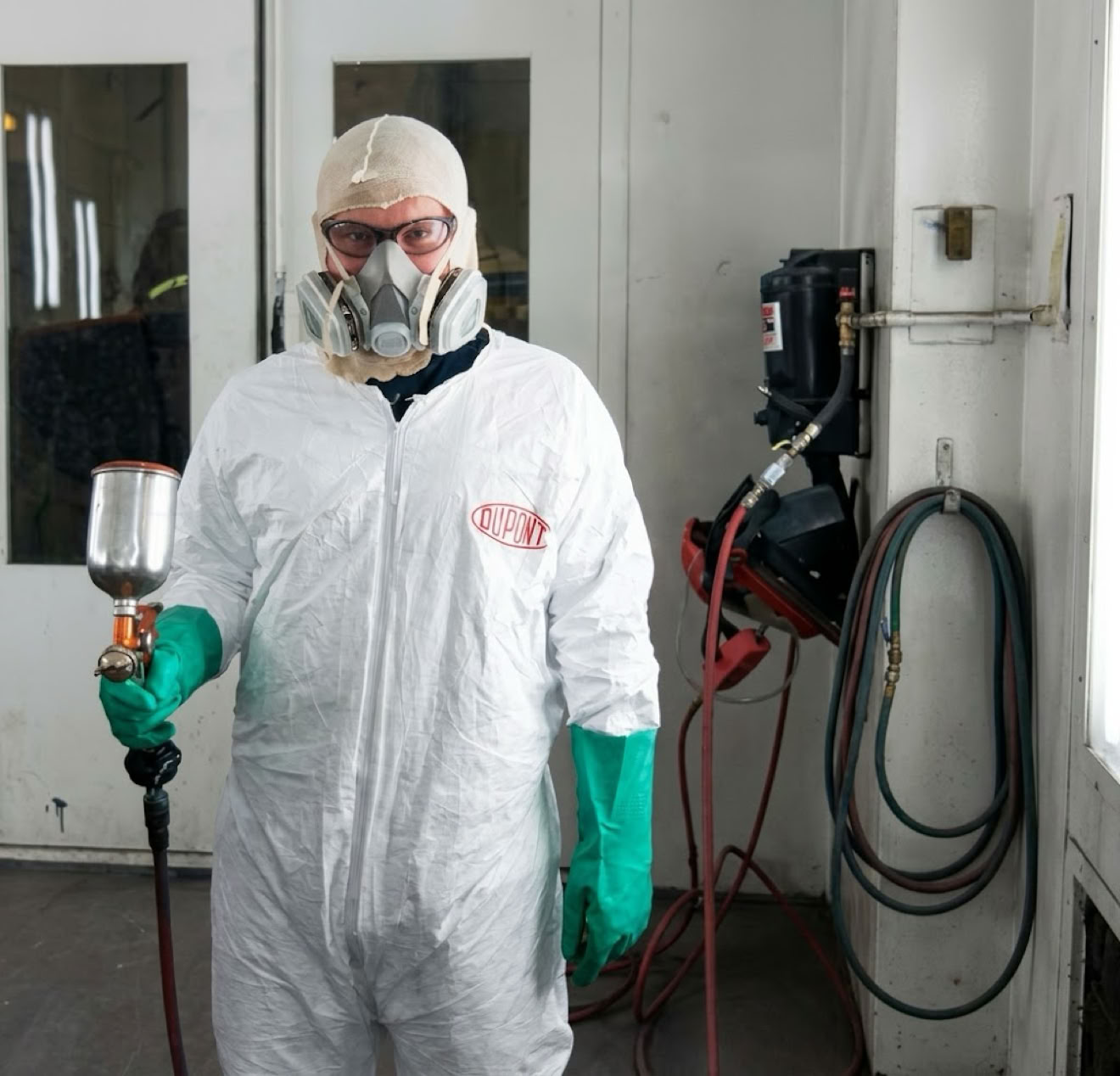
This gear includes the following:
Paint suit—This garment keeps the mist off the painter's skin.
Spray sock—This hood keeps the mist off the painter's hair and neck.
Neoprene gloves—These gloves are impervious to solvents. They protect the painter's skin from exposure to the chemical in the paint.
Respirator—A cartridge-type respirator will protect the technician from the vapors and mists generated by non-isocyanate paints.
Paint containing isocyanates—basecoat, single stage surfacer, or clearcoat—is potentially more hazardous than non-isocyanate paint. While both types of paint can cause long-term organ damage, isocyanate paint can also cause an acute reaction.
As previously mentioned, an unprotected technician who is exposed to isocyanates may have a reaction that occurs immediately after or within hours of exposure.
The symptoms of isocyanate exposure include shortness of breath, wheezing, coughing, and nausea. Prolonged exposure will lead to more serious symptoms.
A painter who becomes sensitized must generally find another occupation. Even small amounts of isocyanates can cause a severe reaction in a sensitized person.
The painting apparel for isocyanate paint is the same as that for non-isocyanate paint. However, a supplied-air respirator must be worn when working with isocyanate paints.
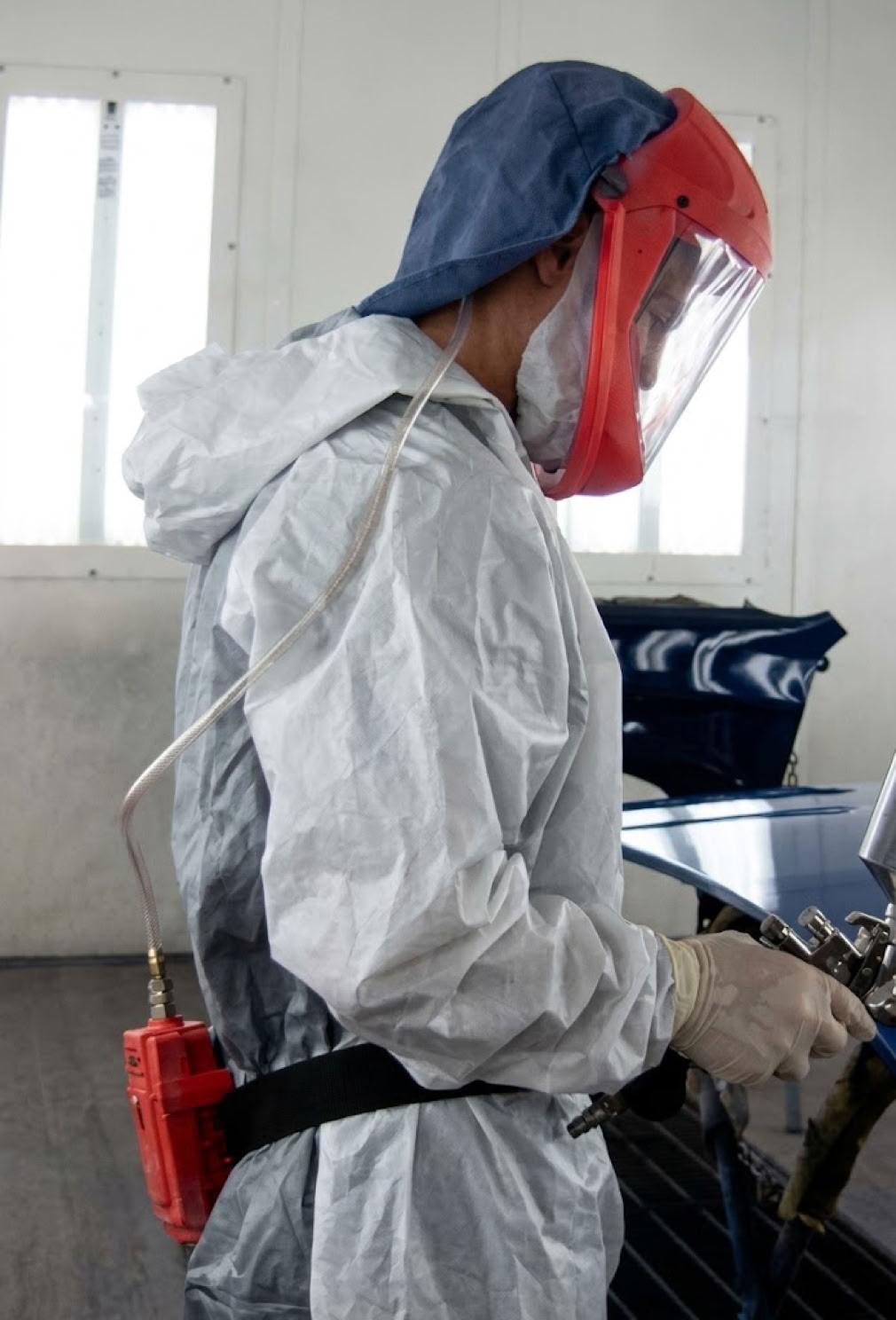
The supplied-air device delivers purified air to the technician. The technician does not breathe air from the spray booth.
Technicians must protect themselves from isocyanates. All spraying should be done in an approved spray booth or prep station.
Spraying isocyanate paint in the open shop will expose unprotected technicians to isocyanates. Vapors from mixing paints must be removed with a power ventilation system.
Mists from spraying must also be removed by power ventilation. Without adequate power ventilation, the isocyanates may be present in the air for hours or days after the paint is sprayed. Change the exhaust filters in the spray booth when they become filled with overspray dust.
Mechanical Repair Safety
Mechanical repairs may involve working on a hot engine or working under the vehicle. Always wear appropriate protective gear when making mechanical repairs.
For example, safety glasses should be worn when grinding or performing other tasks that may generate flying debris.
Care must be taken when working near rotating components, such as the pulleys and drive shafts.
Loose clothing or long hair can get caught in these components, pulling you into the spinning part and causing serious injury. Safety shoes should be worn to protect your feet from falling objects.
A running engine produces carbon monoxide. Carbon monoxide is a toxic gas that is colorless and virtually odorless.
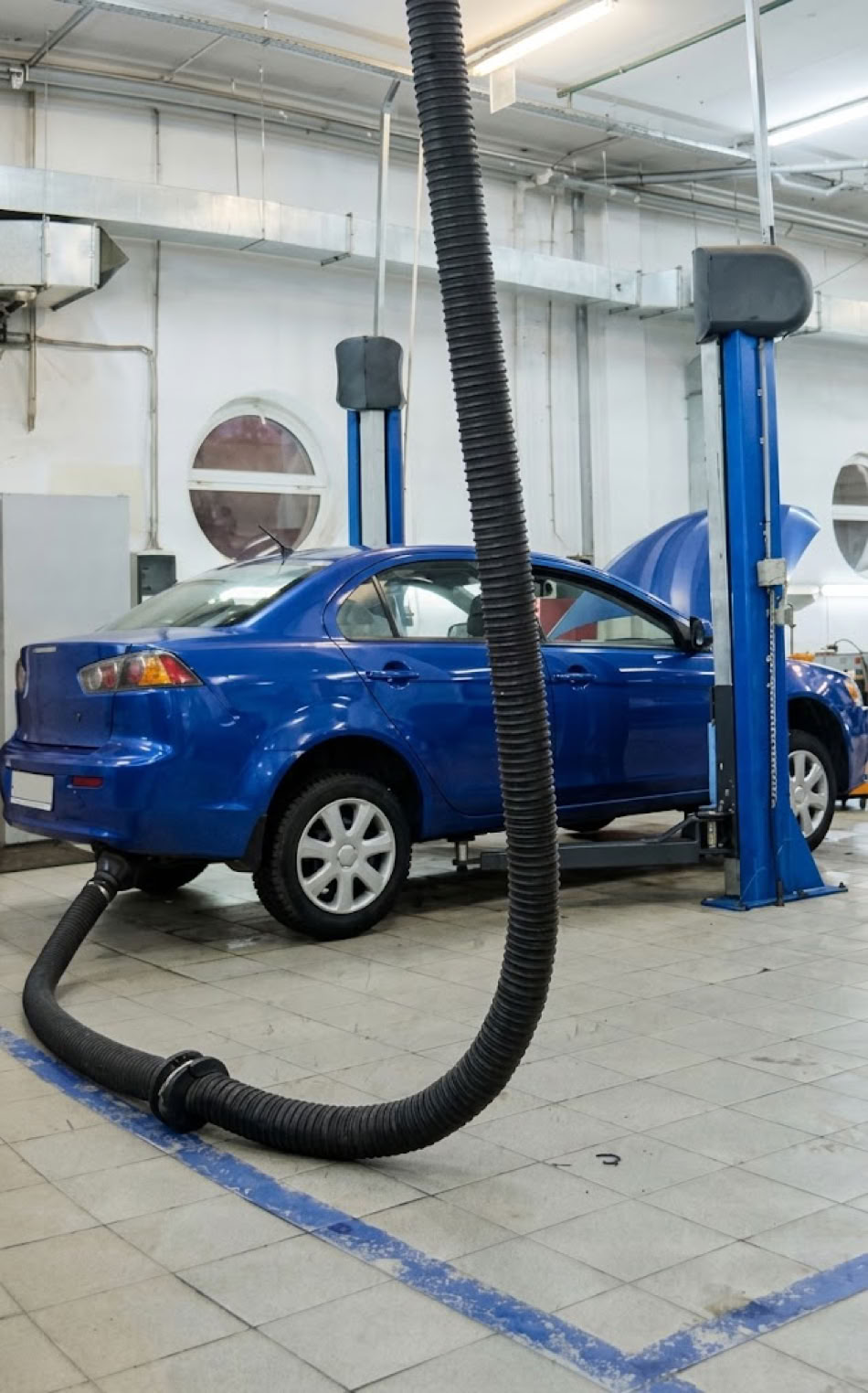
In small quantities, it can cause drowsiness and headaches. In large quantities it can kill. Never run an engine in an enclosed shop.
If you must work on a running engine, move the vehicle outside or connect the vehicle's tailpipe to an exhaust gas ventilation system.
In some cases, vehicles that are damaged in such a way that they will not run or roll can be moved with a floor jack. If necessary, place the damaged vehicle in neutral.
Then lift the vehicle just high enough that the disabled wheels are off the ground and pull or push on the jack to move the vehicle.
A vehicle must often be raised to work beneath it. A lift can be used to raise a vehicle. A floor jack and jack stands can also be used to lift and secure a vehicle. With either method, always raise the vehicle at a recommended lift point.
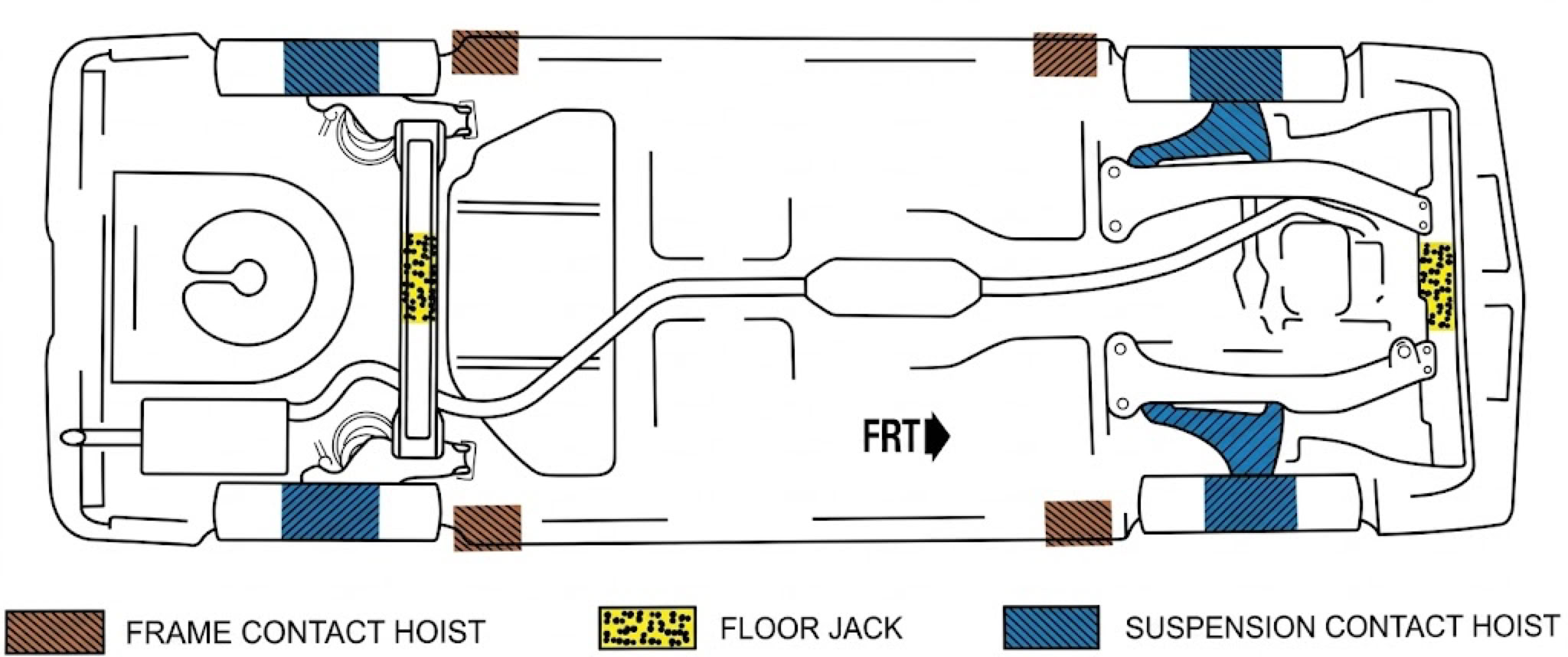
On pickup trucks, the frame, engine cross member, and differential can be used as lift points. On a unibody vehicle, the unirails, radiator support, rocker panels, or rear differential can be used. Know the proper way to operate a lift.
Lifts have instructions for proper use. Obtain the instructions and follow them carefully. Improperly positioned vehicles can fall off the lift. Lifts have built-in stops that prevent the arms from slipping down.
If a floor jack is used to raise a vehicle, properly position jack stands under the appropriate lift points. Then, lower the vehicle on the jack stands. Stay out from under the vehicle when positioning the jack stands.
Only after the vehicle is lowered on the jack stands can you work under the vehicle. Never crawl under a vehicle that is supported only by a floor jack. Vehicles weigh over 2000 pounds (900 kg).
If a floor jack fails, the vehicle will drop to the ground, trapping and possibly killing anyone underneath. Jack stands should be inspected for rust or broken welds before use. Floor jack handles should be kept in the up position at all times.
A floor jack handle in the down position is a tripping hazard. Find, read, and follow the manufacturer's safety instructions for working on a hybrid or an all-electric vehicle. The battery must be disconnected when working on the power train. The high-voltage battery can be dangerous if safety instructions are not followed.
Hazardous Wastes
Collision repair and refinishing operations produce many hazardous wastes. These wastes include leftover paint, contaminated solvent, and used spray booth exhaust filters. Leftover paint is paint that was reduced but not used.
Contaminated solvent is generated from spray gun cleaning. Spray booth exhaust filters become clogged with overspray. A collision repair technician should always look for ways to reduce hazardous wastes. One way to reduce hazardous waste is to recycle contaminated solvent. A thinner recycler cleans contaminated thinner.
The contaminated thinner is heated inside the recycler. The thinner, but not the contaminants, changes from a liquid to a gas. The clean thinner, in gaseous form, is then cooled. As the thinner is cooled, it condenses, or changes from a gas to a liquid.
The recycled thinner can then be used to clean other spray guns. The contaminants from the recycling process can be disposed of as hazardous waste. However, some shops use the contaminants, which are just paint, as an undercoat or a sound deadener.
Another way to reduce the amount of hazardous waste generated and save spray gun cleaning time is to use a disposable spray gun cup liner. The plastic cup liner protects the spray gun cup from paint. After use, the cup liner is simply thrown away.
When the liner is used, the only part of the spray gun that must be cleaned is the internal paint passage. This saves on thinner and time. Spraying all the paint that is mixed will also help reduce hazardous wastes.
For example, if a red paint is mixed for a job and not all the paint is used on the vehicle, the paint can be used on the next red car painted. The color may not match, but the paint can be used to cover up the undercoat and the proper color can be sprayed over it.
Environmental Regulations
The hazardous wastes generated by collision repair and refinishing operations must be disposed of properly to prevent damage to the environment. Federal and state governments have established regulations governing the ways hazardous wastes should be handled.
Federal regulations apply throughout the United States. They form the basis of state regulations. State regulations can be more restrictive than the federal regulations but not less restrictive.
Local regulations in each state follow the same guidelines. The local regulations must be at least as rigorous as the state regulations. They cannot be more lenient.
Environmental Protection Agency
The Environmental Protection Agency (EPA) helps protect human health and the environment by regulating industries that generate air, water, and land pollution. EPA regulations state that the collision repair shop is responsible for all hazardous wastes it generates.
In fact, the shop has "cradle-to-grave" responsibility, which means the shop is responsible for hazardous material from the time it enters the shop until the hazardous waste is properly disposed of.
Most collision repair shops contract with a hazardous waste disposal company. The company moves the hazardous waste from the collision repair shop to the disposal site.
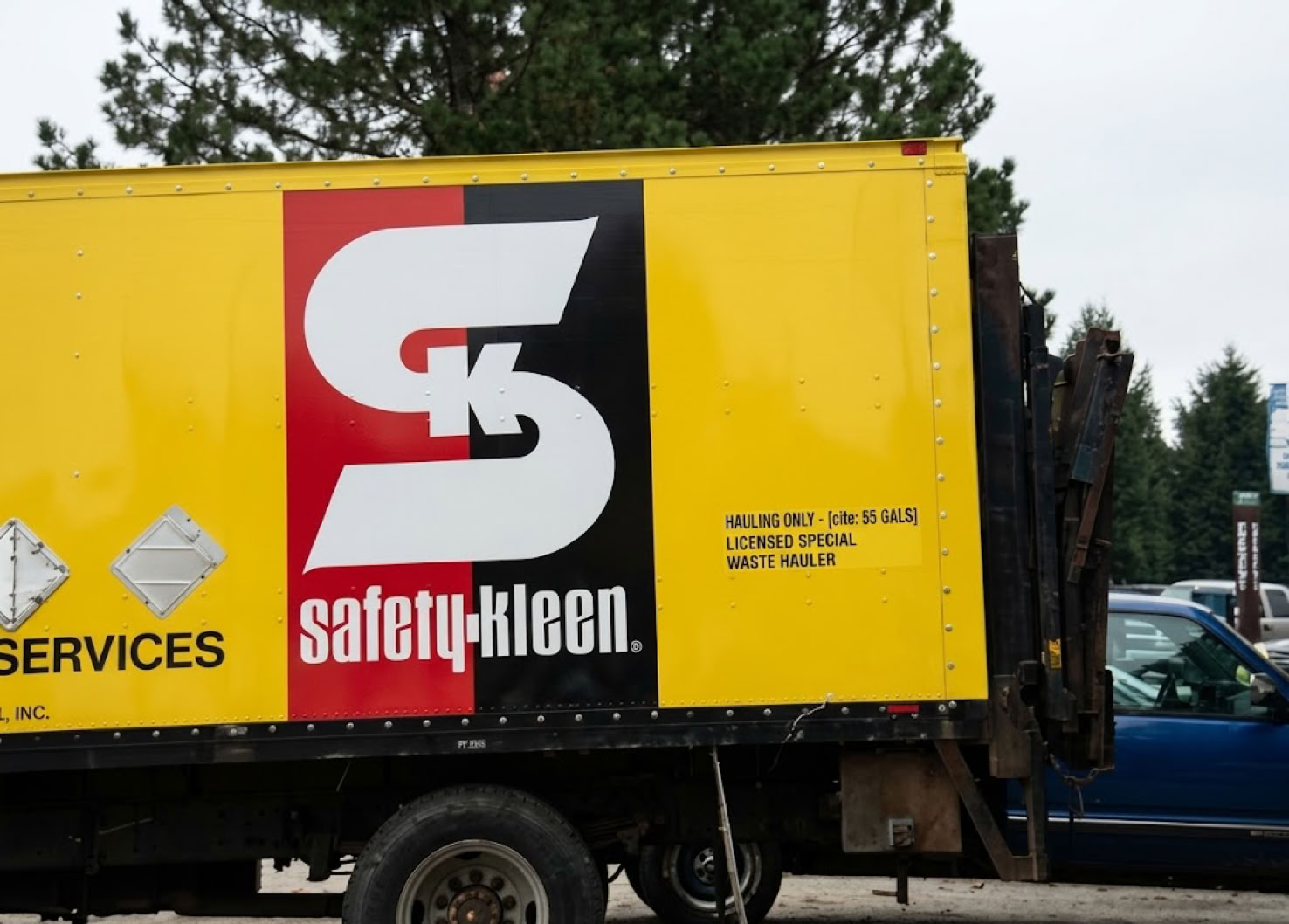
The waste paint and solvent is often incinerated. The collision repair shop, which is referred to as the generator, is responsible for the waste even after the disposal company picks it up. If the company does not dispose of the waste in an approved manner, the shop is liable.
Each collision repair shop is required to have an EPA hazardous waste disposal number. This number allows the EPA to track the proper disposal of hazardous waste. The amount and type of hazardous waste produced determines which regulations the collision repair shop must follow.
A Conditionally Exempt Small Quantity Generator produces less than 220 pounds (120 kg) of hazardous waste in a calendar month. These shops can store up to 2,200 pounds (997 kg) of hazardous waste. The waste must be kept in labeled containers and disposed of properly.
A Small Quantity Generator produces between 220 and 2,200 pounds of hazardous waste per calendar month. The Small Quantity Generator can store up to 13,228 pounds (6000 kg) of hazardous waste up to 180 days.
The requirements for the Small Quantity Generator are more demanding than those for the Conditionally Exempt Small Quantity Generator. These requirements include storing waste in a closed, labeled, compatible container, as well as having a plan for spills.
Volatile organic compound (VOC) laws are also EPA regulations that affect collision repair shops. VOCs are released into the atmosphere when paint is sprayed and while it dries. VOCs in the atmosphere react with sunlight to produce photochemical smog and ground-level ozone.
The Environmental Protection Agency regulation of VOCs began with the Clean Air Act of 1990. In addition, some heavily populated areas in the United States, such as Southern California, required collision repair shops to use only HVLP spray guns in order to reduce VOC emissions.
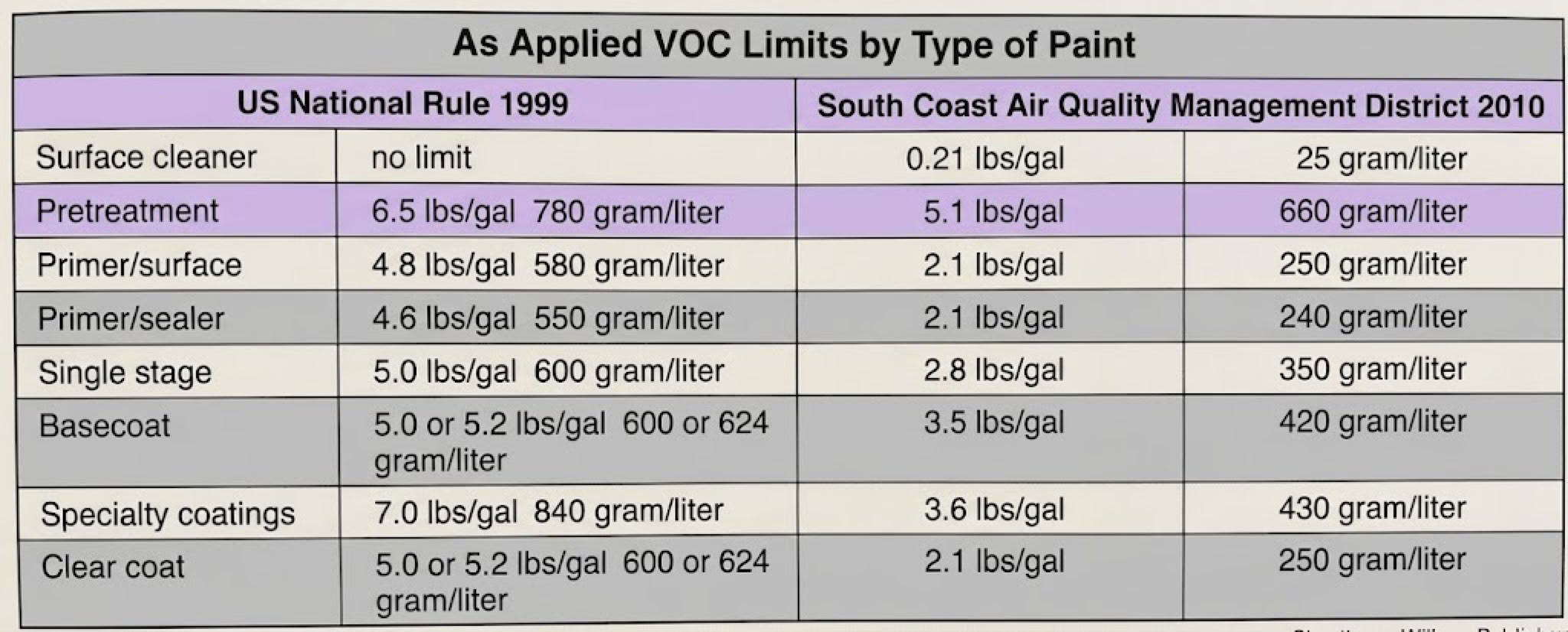
In 1999, the EPA introduced the National Volatile Organic Compound Emission Standards for Automobile Refinish Coatings, commonly known as National Rule. The National Rule limits the amount of VOCs in paint and measures VOC's as pounds per gallon.
There are two ways the amount of VOCs can be specified for paint: as supplied and as applied. As supplied measures the amount of VOCs in the can, before the paint is mixed. Most paint must be mixed with a reducer or hardener before spraying.
As applied measures the amount of VOCs in paint after the reducer or hardener has been added to create a sprayable mixture. Paint manufacturers formulate their products to comply with the National Rule.
Heavily populated areas in the United States must adhere to stricter EPA requirements. In addition to complying with the National Rule, shops in these areas must use HVLP spray guns, use spray booth exhaust filters that have a 98% capture efficiency, keep detailed records of wastes generated, and allow periodic spray booth inspections.
Exempt solvents are volatile solvents that can be used to dilute paint for spraying but do not make ground-level ozone when exposed to nitrogen oxides and sunlight. Examples of exempt solvents are: isopropanol, ethyl acetate, and acetone.
Exempt solvents do not count toward VOC as applied totals. Exempt solvents may be used to make low-VOC solvent-borne paint. Users of low-VOC solvent-borne paints may have trouble matching OEM metallic colors.