Collecting blood from pediatric patients presents technical challenges. Because greater technical expertise is required to perform phlebotomy on children than on adults, you should master your collection methods on adult patients first. Similarly, you should master collection in older children before moving on to young children and infants.
SUPPLIES:
When performing venipuncture, use shorter needles, if possible, and use the smallest gauge consistent with the requirements of the tests(23g butterfly). Butterfly needles and smaller, partial-fill tubes should be used for pediatric draws.
Take along a selection of rewards, such as stickers or small toys. Keep a stock of cartoon bandages as well.
Remember not to use these on infants younger than 2 years due to the danger of adhesive allergies.
ANESTHETICS:
Topical anesthetic cream may be useful for venipuncture procedures in pediatric patients. The most commonly used agent is EMLA (eutectic mixture of local anesthetics).
It must be applied 60 minutes before the draw, however, which means that the site must be chosen at that time. It is possible to numb more than one area if it is not practical to choose the site ahead of time.
Neonatal Screening:
Neonatal screening tests are used to detect inherited metabolic disorders that cause severe brain damage. U.S. law mandates screening for PKU.
Specimen Collection:
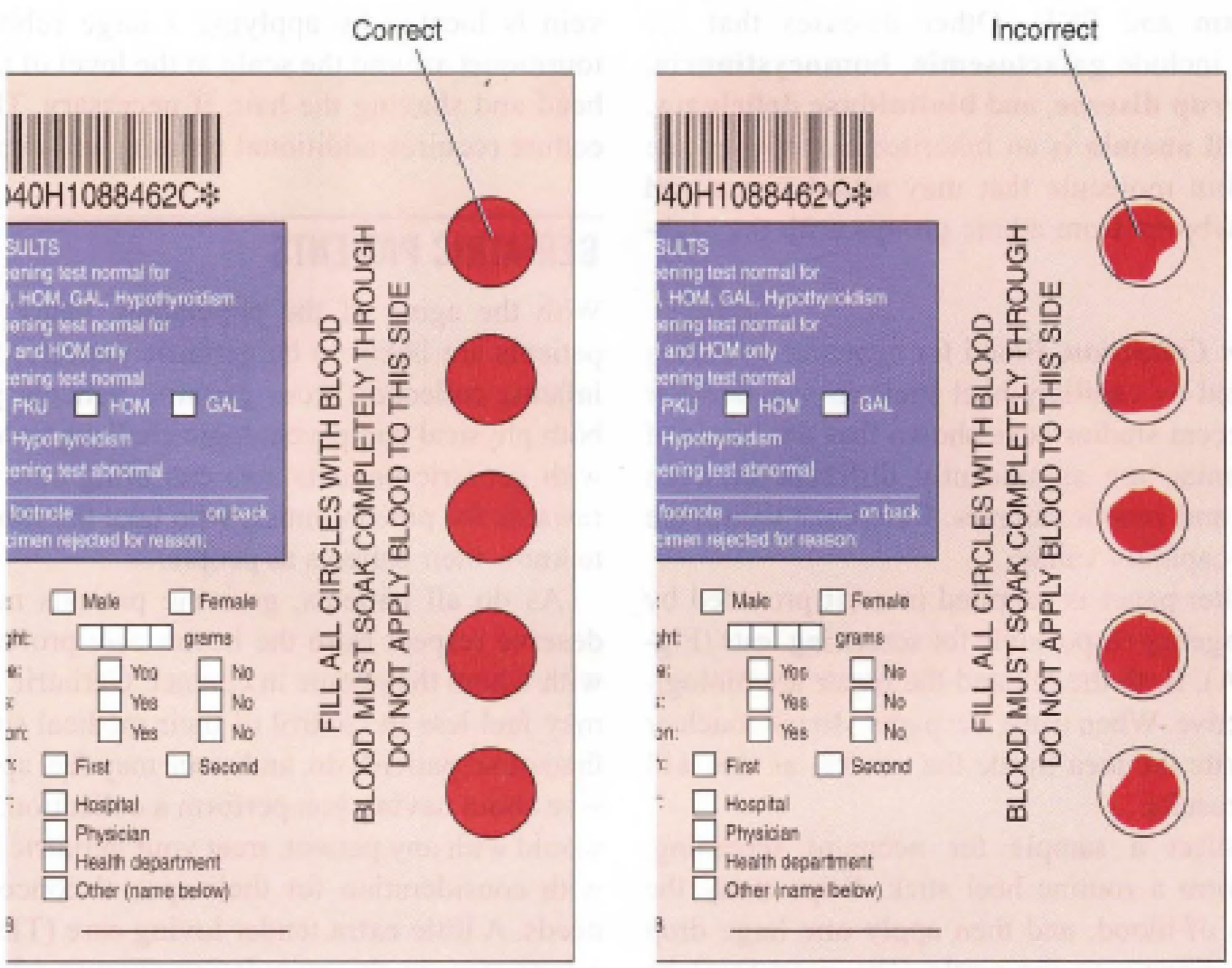
Blood for neonatal screening is collected by capillary heel stick on special filter paper. Recent studies have shown that the levels of phenylalanine are significantly different between capillary and venous samples.
Reference values are based on capillary values. The filter paper is supplied in a kit provided by the state agency responsible for screening tests.
To collect a sample for neonatal screening, first perform a routine heel stick. Wipe away the first drop of blood, and then apply one large drop of blood directly to the circle.The drop must be evenly spread. Although applied to
only one side of the filter paper, the blood should be visible from both sides. Air-dry the specimen in a suspended horizontal position. Keep it at room temperature and away from direct sunlight until it is delivered to the lab.
GERIATRIC PATIENTS
With the aging of the population, many of your patients are likely to be geriatric patients. As with infants, collection from geriatric patients presents both physical and psychologic challenges.
PHYSICAL CHANGES:
As people age, their bodies undergo a number of changes that may have an impact on the safety and effectiveness of normal collection procedures.
Skin changes are among the most important. The skin becomes less elastic, and the layers of skin become thinner. Bruising is more likely, and it takes longer to replace cells, so longer healing times are needed.
Applying the Tourniquet:
If you are performing venipuncture, you can apply the tourniquet over clothing, a washcloth or paper towels to limit bruising.
Do not apply the tourniquet as tightly as you would normally, because veins in geriatric patients collapse more easily, and release the tourniquet immediately after inserting the needle.
Locating the Vein:
To improve access and comfort, place the arm on a phlebotomy wedge
SPECIAL EQUIPMENT USED IN THE INTENSIVE CARE UNIT AND EMERGENCY ROOM
Patients in the ICU or ER are likely to have some type of vascular access device or line in place that may affect your collection.
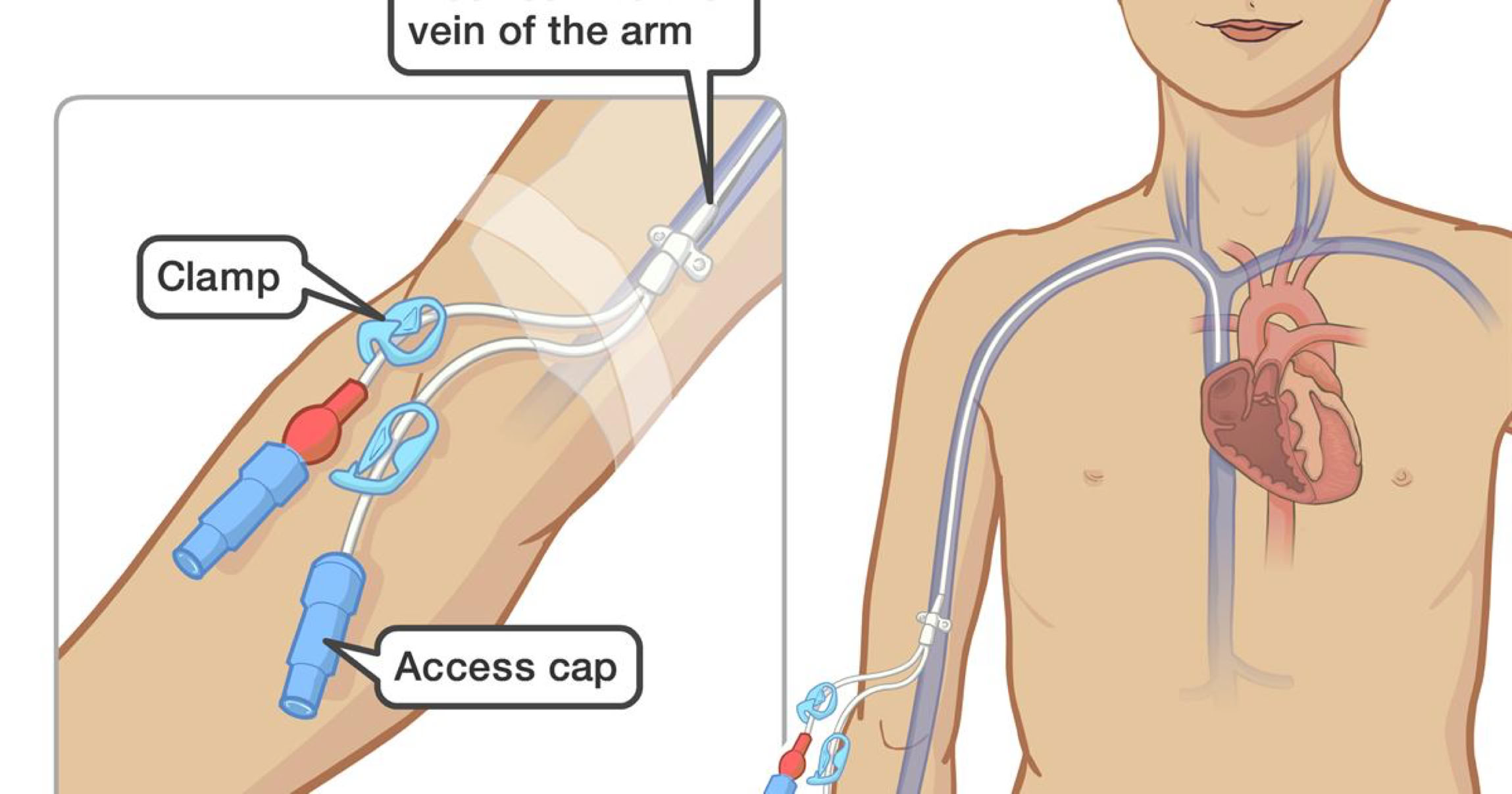
A VAD is a tube that is inserted into either a vein or an artery and is used to administer fluids, medications or draw blood.
Blood collection from a VAD is done only by trained personnel on the physician's order.
Understanding the types of devices and the requirements they impose will improve your ability to work in these areas.
TYPES OF VASCULAR ACCESS DEVICES:
A central venous catheter (CVC), also called a central venous line is the most common type of VAD.
Central Venous Catheters are inserted from the left arm and empty into the heart.
Access is gained through the several inches of tubing that sit outside the entry site.
A peripherally inserted central catheter (PICC) is threaded into a central vein after insertion into a peripheral (noncentral) vein, usually the basilic or cephalic, accessed from the antecubital area.
As stated earlier, only specially trained personnel can draw blood from a VAD, and usually only with the physician 's order.
Arterial Punctures
Arterial Punctures are used in diagnosis & management of respiratory disorders
Personnel Who Perform Arterial Puncture
• Nurse
• Medical Technologist & technicians
• Respiratory Therapist
• Emergency medical technicians
Non-blood Specimens should be labeled with same ID information as blood specimens
Labeling should include type & source of specimen
Label should be applied to container, not lid, as lid is removed for testing
All body substances are potentially infectious
Standard precautions must be observed in handling them
Urine
Most frequently analyzed non-blood body fluid
Readily available, easy to collect & inexpensive to test.
Its analysis can aid in:
Monitoring wellness, Diagnosis & treatment of urinary tract infections and determining effectiveness or complications of therapy
Accurate results depend on:
Collection method
Container used
Specimen transportation & handling
Timeliness of testing
Routine Urinalysis (UA)
It is the most commonly requested urine test. It screens for urinary & systemic disorders
Culture & Sensitivity
Ordered for patients with symptoms of urinary tract infection. Requires midstream clean-catch collection in sterile container
1) Place measure portion of urine on special nutrient medium that encourages growth of microorganisms
2) Incubate for 18 to 24 hrs
3) Identify any microorganisms that grow
4) If microorganism is identified, sensitivity test is performed to determine which antibiotics will be effective
Urine drug screening performed to detect:
Illicit use of recreational drugs
Use of anabolic steroids to enhance performance in sports
Unwarranted use of prescription drugs
Tests are performed in groups based on drug classifications
Urine pregnancy testing
Tests for HCG, a hormone appearing in urine after conception
First morning specimen is preferred due to higher concentration
Types of Urine Specimens
Random: collected at any time
First morning/8-hour: collected on waking after 8hrs sleep
Fasting: second specimen voided after fasting (glucose monitoring)
Tolerance test (glucose)
2-hour postprandial (2hrs after meal)
24-hour (collection & pooling of all urine voided in 24 hrs.)
Double-voided (empty bladder, wait specified time, then collect specimen)
Urine Collection Methods
1) Regular Voided: patient voids into clean container
2) Mainstream: Patient voids into toilet first, then container
3) Midstream clean catch: requires cleaning of genital area before collection
4) Catheterized: sterile catheter inserted through urethra into bladder
5) Suprapubic aspiration: Collected by inserting needle directly into bladder 6) Pediatric: collected in plastic bag, for children not potty trained
Nasopharyngeal Secretions
From nasal cavity and pharynx
Cultured to detect presence of micro-organsims causing:
Diphtheria
Pertussis (whooping cough)
Pneumonia
Collected using sterile Dacron or cotton tipped flexible wire swab. Swab is inserted into nose & passed into nasopharynx. It is rotated, removed, placed in sterile container, labeled, sent to lab
Sputum
Mucous or phlegm ejected from trachea, bronchi and lungs and is collected for diagnosis or monitoring of lower respiratory tract infectious (tuberculosis).
First morning specimens are preferred (larger volume). Collect at least 1 hr after a meal to avoid gagging or vomiting.
Patient takes 3 or 4 deep breaths and then coughs forcefully, expelling sputum into container
Buccal (cheek) Swabs
Less invasive, painless alternative to blood collection for obtaining cells for DNA analysis
Phlebotomist gently massages mouth on inside of cheek with swab and DNA is extracted from cells on swab
Feces(stool)
Useful in evaluation of gastrointestinal disorders
Stool specimens can be evaluated for presence of intestinal parasites & their eggs, Checked for fat content, Cultured to detect presence of pathogenic bacteria & viruses and tested for presence of occult blood using guaiac test
Throat swabs
Collected to aid in diagnosis of strep infections. Nurses collect form inpatients, phlebotomists from outpatients
Collected with a sterile polyester-tipped swab in covered transport tube containing transport medium